
Auth0 SSO Configuration (Confidential)
Auth0 SSO enables users to log in to Collate using their Auth0 credentials via OAuth 2.0 and OpenID Connect (OIDC). This configuration supports Confidential Clients using both Client ID and Client Secret for secure backend authentication.Overview
Collate supports Single Sign-On (SSO) integration with various identity providers, enabling secure, centralized user authentication.-
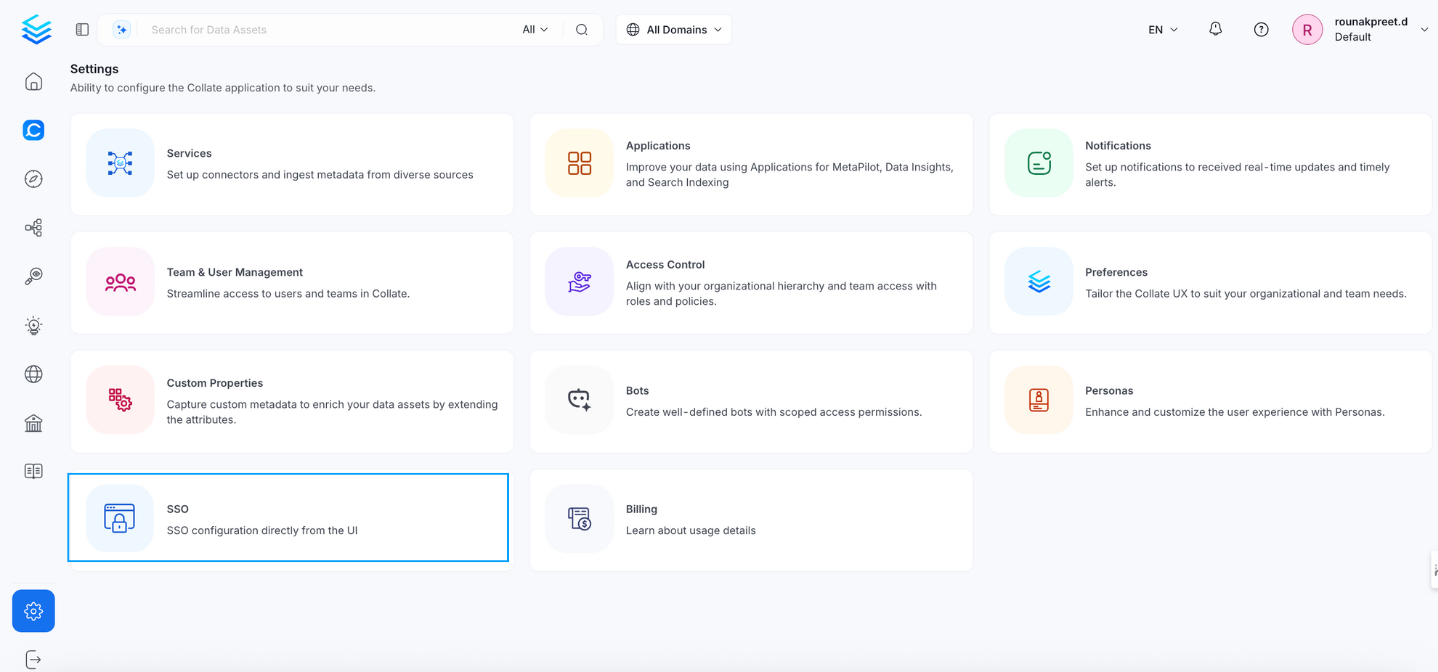
Navigate to Settings > SSO.
-
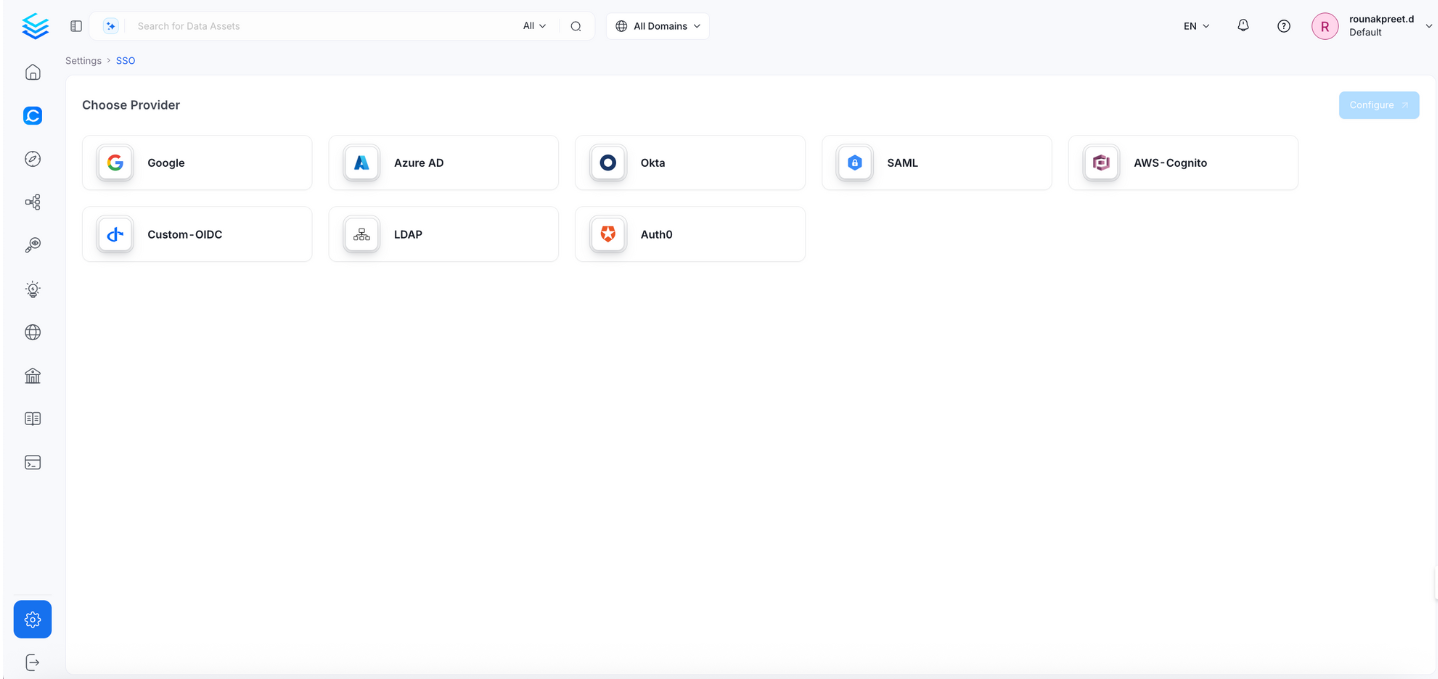
Select the service provider.
-
Click Configure to set up Single Sign-On (SSO). See Confidential Configuration Fields.
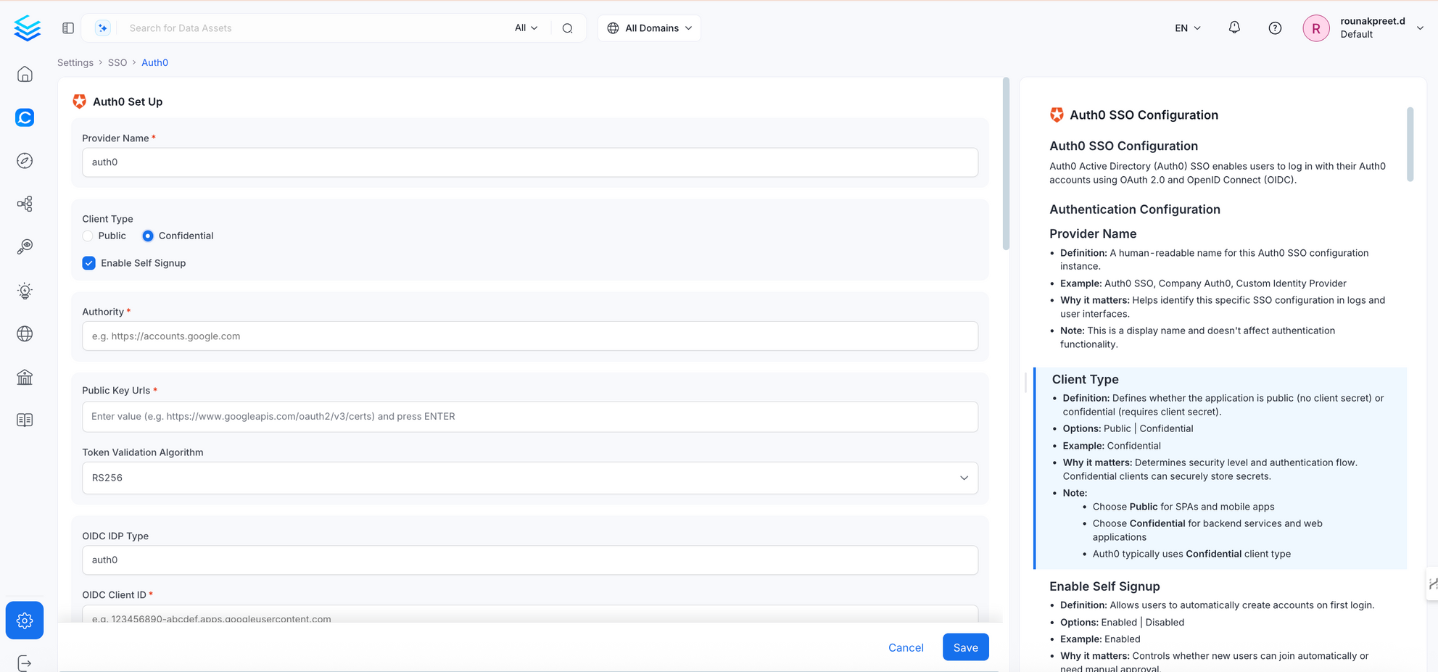
- Click Save to finish the SSO configuration.
Confidential Configuration Fields
This section lists all fields in the order they appear in the Collate SSO configuration form.Authentication Configuration
Configure the identity provider connection and basic authentication behavior.Provider Name
- Definition: A human-readable name for this Auth0 SSO configuration instance.
- Example:
Auth0 SSO,Company Auth0,Custom Identity Provider - Why it matters: Helps identify this specific SSO configuration in logs and user interfaces.
- Note: This is a display name and doesn’t affect authentication functionality.
Client Type
- Definition: Defines whether the application is public (no client secret) or confidential (requires client secret).
- Options: Public | Confidential
- Example: Confidential
- Why it matters: Determines security level and authentication flow. Confidential clients can securely store secrets.
- Note:
- Use
Confidentialfor backend services and web applications. - Use
Publicfor SPAs and mobile apps. - Auth0 typically uses Confidential client type.
- Use
Enable Self Signup
- Definition: Allows users to automatically create Collate accounts on their first SSO login.
- Options: Enabled | Disabled
- Example: Enabled
- Why it matters: Controls whether new users join automatically or need manual provisioning.
- Note: Disable for stricter control over user access.
Authority
- Definition: Auth0 endpoint that issues tokens for your tenant.
- Example:
https://dev-abc123.us.auth0.com - Why it matters: Tells Collate which Auth0 tenant to authenticate against.
- Note: Replace
dev-abc123with your actual Auth0 tenant domain.
OIDC Configuration
Configure the OIDC client credentials and token handling; these fields appear when Client Type is set to Confidential.OIDC Client ID
- Definition: Application (client) ID for OIDC authentication with Auth0.
- Example:
abc123def456ghi789jkl012mno345pqr - Why it matters: Identifies your application to Auth0 in OIDC flows.
- Note: Found in Auth0 → Applications → Your app → Settings under Client ID.
OIDC Client Secret
- Definition: Secret key for confidential client authentication with Auth0.
- Example:
abc123def456ghi789jkl012mno345pqr678st - Why it matters: Required for confidential clients to securely authenticate with Auth0.
- Note:
- Found in Auth0 → Applications → Your app → Settings (scroll to Client Secret).
- Store securely and rotate regularly.
Scope
- Definition: Permissions requested from Auth0 during authentication.
- Default:
openid email profile - Example:
openid email profile - Why it matters: Determines what user information Collate can access.
- Note:
openid email profileis sufficient for most use cases.
OIDC Discovery URI
- Definition: Auth0’s OpenID Connect metadata endpoint.
- Example:
https://dev-abc123.us.auth0.com/.well-known/openid-configuration - Why it matters: Allows Collate to automatically discover Auth0’s OIDC endpoints.
- Note: Replace
dev-abc123with your actual Auth0 tenant domain.
OIDC Callback URL
- Definition: URL where Auth0 redirects after authentication.
- Example:
https://openmetadata.company.com/callback - Why it matters: Must be registered in your Auth0 configuration.
- Note:
- This field is read-only — it is auto-populated as
{your-domain}/callback. - Copy this URL and add it to Auth0’s allowed redirect URIs list.
- This field is read-only — it is auto-populated as
OIDC Prompt
- Definition: Controls Auth0’s authentication prompt behavior.
- Options:
none,login,consent,select_account - Example:
select_account - Why it matters: Defines how the login experience behaves for users.
- Note:
login: Always prompt for credentials.consent: Prompt for permissions.select_account: Show account picker.
OIDC Custom Parameters
- Definition: Additional parameters to include in OIDC authentication requests.
- Example:
{"prompt": "select_account", "domain_hint": "company.com"} - Why it matters: Allows customization of Auth0 authentication behavior.
- Note: Common parameters include
prompt,domain_hint,login_hint.
Advanced Configuration
The following fields are grouped under Advanced Config in the UI (collapsed by default):OIDC Use Nonce
- Definition: Security feature to prevent replay attacks in OIDC flows.
- Default:
false - Why it matters: Enhances security by ensuring each authentication request is unique.
OIDC Disable PKCE
- Definition: Whether to disable Proof Key for Code Exchange.
- Default:
false - Why it matters: PKCE adds security to the authorization code flow.
- Note: Should remain
false(enabled) in most cases.
OIDC Max Clock Skew
- Definition: Maximum allowed time difference in seconds between systems when validating tokens.
- Example:
0 - Why it matters: Prevents token validation failures due to minor clock differences between servers.
OIDC Token Validity
- Definition: Duration in seconds that tokens remain valid.
- Default:
3600 - Example:
3600 - Why it matters: Balances token lifetime against security requirements.
OIDC Max Age
- Definition: Maximum authentication age in seconds before re-authentication is required.
- Example:
3600 - Why it matters: Controls how frequently users must re-authenticate.
OIDC Session Expiry
- Definition: How long user sessions remain valid in seconds.
- Default:
604800(7 days) - Why it matters: Controls session timeout for confidential clients.
JWT Claims
Map identity token claims to Collate user identities and team assignments.JWT Principal Claims
- Definition: JWT fields used to identify users in Collate. The first claim that returns a value is used.
- Default:
["email", "name", "sub"] - Example:
["email", "name", "sub"] - Why it matters: Determines how users are matched to their Collate accounts.
- Note:
- At least one claim must correspond to the user’s email address.
- Common Auth0 claims:
email,name,sub,nickname. - Order matters — the first matching claim is used.
JWT Principal Claims Mapping
Definition: Maps JSON Web Token (JWT) claims to Collate user profile fields. Supported keys: Onlyemail and username are valid mapping targets in jwtPrincipalClaimsMapping.
Example:
collate_field:jwt_claim (for example, "email:email").
Note: The display name is derived automatically from standard OIDC/JWT claims — you don’t need to configure it using
jwtPrincipalClaimsMapping. If you need richer name handling, make sure Auth0 includes given_name and family_name as claims in the ID token — Collate will pick them up automatically.JWT Team Claim Mapping
- Definition: Auth0 claim containing team or department information for automatic team assignment in Collate.
- Example:
department,groups,organization - Why it matters: Automatically assigns users to existing Collate teams based on their Auth0 user profile at login.
- Note:
- Standard Auth0 profile fields:
department,organization. - For group-based teams, use
groupsorrolesclaims (configure via Auth0 Rules or Actions). - The team must already exist in Collate for assignment to work.
- Only teams of type Group can be auto-assigned. Team names are case-sensitive.
- Standard Auth0 profile fields:
Authorizer Configuration
Control which users and domains are permitted to access Collate.Admin Principals
- Definition: Users granted admin access in Collate.
- Example:
["admin", "superuser"] - Why it matters: Grants full admin privileges in Collate.
- Note: Enter usernames only — not email addresses. Use the part of the email before
@(for example, foradmin@company.com, enteradmin).
Principal Domain
- Definition: Default domain for user principals.
- Example:
company.com - Why it matters: Used to construct full user identifiers when only a username is provided.
Enforce Principal Domain
- Definition: Restricts login to users belonging to the configured Principal Domain.
- Default:
false - Example:
true - Why it matters: Adds an extra layer of security by limiting access to a specific domain.
Enable Secure Socket Connection
- Definition: Enables SSL/TLS for all SSO communication.
- Default:
false - Example:
true - Why it matters: Ensures encrypted communication between Collate and Auth0.
- Note: Recommended in production environments.
Allowed Domains
- Definition: List of email domains permitted to authenticate with Collate.
- Example:
["company.com", "partner-company.com"] - Why it matters: Provides fine-grained control over which email domains can log in via Auth0.
- Note:
- Works in conjunction with Enforce Principal Domain.
- Leave empty if you only use a single domain configured in Principal Domain.
Use Roles From Provider
- Definition: Use roles returned by Auth0 in the token to assign Collate roles.
- Default:
false - Why it matters: Enables role-based access control driven by your Auth0 role assignments.
- Note: Roles must be included in the Auth0 token and must match existing Collate role names.
Default OAuth Role
- Definition: Default role assigned to new users when they first sign in via SSO self-signup.
- Example:
DataConsumer - Why it matters: Controls the starting permission level for new users who join through self-signup.
- Note: Leave empty to create users without any role. Requires Enable Self Signup to be active. The role must already exist in Collate.
Summary
Quick reference of all configuration fields and their example values.Troubleshooting
If users are automatically logged out and unable to log in again due to a bad authentication configuration, you can reset the security setup using the following command:Docker Security
Configure Auth0 SSO to access the UI and APIs.
Bare Metal Security
Configure Azure SSO to access the UI and APIs.
Kubernetes Security
Configure a custom OIDC SSO to access the UI and APIs.
Google SSO
Configure Google SSO to access the UI and APIs.
Okta SSO
Configure Okta SSO to access the UI and APIs.
Amazon Cognito SSO
Configure Amazon Cognito SSO to access the UI and APIs.
SAML
Configure SAML SSO to access the UI and APIs.
LDAP
Configure LDAP SSO to access the UI and APIs.