
Upgrade on Kubernetes
This guide will help you upgrade your OpenMetadata Kubernetes Application with automated helm hooks.Requirements
This guide assumes that you have an OpenMetadata deployment that you installed and configured following the Kubernetes Deployment guide. We also assume that your helm chart release names areopenmetadata and openmetadata-dependencies and namespace used is default.
Prerequisites
Everytime that you plan on upgrading OpenMetadata to a newer version, make sure to go over all these steps:Backup your Metadata
Before upgrading your OpenMetadata version we strongly recommend backing up the metadata. The source of truth is stored in the underlying database (MySQL and Postgres supported). During each version upgrade there is a database migration process that needs to run. It will directly attack your database and update the shape of the data to the newest OpenMetadata release. It is important that we backup the data because if we face any unexpected issues during the upgrade process, you will be able to get back to the previous version without any loss. Since version 1.4.0, OpenMetadata encourages using the builtin-tools for creating logical backups of the metadata: For PROD deployment we recommend users to rely on cloud services for their databases, be it AWS RDS, Azure SQL or GCP Cloud SQL. If you’re a user of these services, you can leverage their backup capabilities directly: You can refer to the following guide to get more details about the backup and restore:Backup Metadata
Learn how to back up MySQL or Postgres data.
Understanding the “Running” State in OpenMetadata
In OpenMetadata, the “Running” state indicates that the Collate server has received a response from Airflow confirming that a workflow is in progress. However, if Airflow unexpectedly stops or crashes before it can send a failure status update through the Failure Callback, OpenMetadata remains unaware of the workflow’s actual state. As a result, the workflow may appear to be stuck in “Running” even though it is no longer executing. This situation can also occur during an OpenMetadata upgrade. If an ingestion pipeline was running at the time of the upgrade and the process caused Airflow to shut down, OpenMetadata would not receive any further updates from Airflow. Consequently, the pipeline status remains “Running” indefinitely.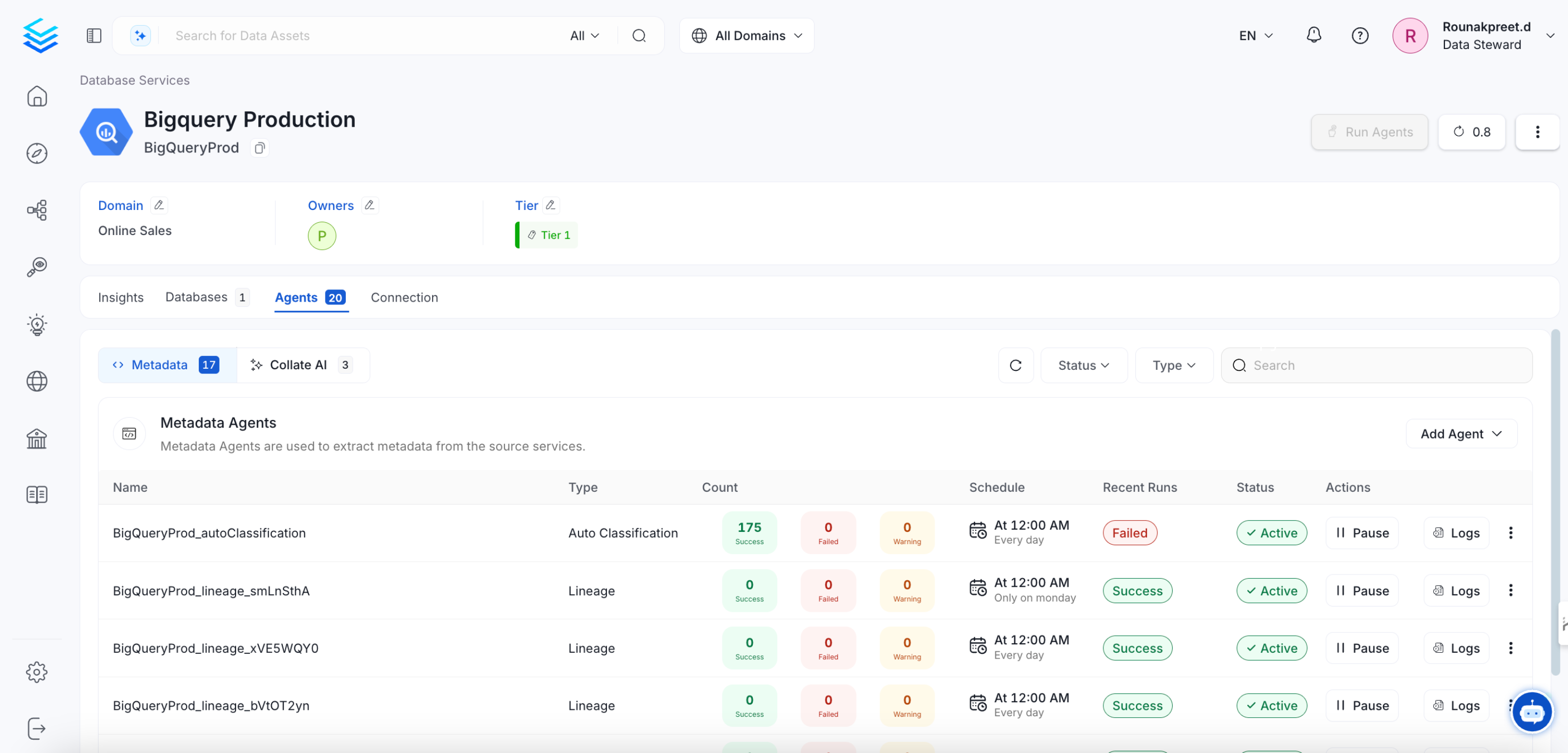
Expected Steps to Resolve
To resolve this issue:- Ensure that Airflow is restarted properly after an unexpected shutdown.
- Manually update the pipeline status if necessary.
- Check Airflow logs to verify if the DAG execution was interrupted.
Update sort_buffer_size (MySQL) or work_mem (Postgres)
Before running the migrations, it is important to update these parameters to ensure there are no runtime errors.
A safe value would be setting them to 20MB.
If using MySQL
You can update it via SQL (note that it will reset after the server restarts):
my.ini or my.cnf files with sort_buffer_size = 20971520.
If using RDS, you will need to update your instance’s Parameter Group
to include the above change.
If using Postgres
You can update it via SQL (not that it will reset after the server restarts):
postgresql.conf file
with work_mem = 20MB.
If using RDS, you will need to update your instance’s Parameter Group
to include the above change.
Note that this value would depend on the size of your query_entity table. If you still see Out of Sort Memory Errors
during the migration after bumping this value, you can increase them further.
After the migration is finished, you can revert this changes.
Backward Incompatible Changes
2.0.0
Great Expectations requires version 1.3 or later
The validation action now requires Great Expectations 1.3 or later. Collate 2.0 drops support for the 0.18 line, andopenmetadata-ingestion[great-expectations] now installs great-expectations~=1.3. The separate great-expectations-1xx
extra no longer exists.
If you adopted the interim GX 1.x module, rename it in your checkpoint. metadata.great_expectations.action1xx and
OpenMetadataValidationAction1xx have been removed:
metadata.great_expectations.action and OpenMetadataValidationAction keep those
names. The surrounding checkpoint definition still has to move to the GX 1.x API. Pass actions as objects to
Checkpoint(actions=[...]) rather than as an action_list of dictionaries, and call checkpoint.run() instead of
great_expectations checkpoint run. See the Great Expectations guide for
the updated configuration.
Great Expectations test results report counts instead of percentages
Test case results now report row counts only —unexpected_count, missing_count, element_count, and
observed_value. The percentage values (unexpected_percent, unexpected_percent_total, missing_percent, and
success_rate) are no longer sent, because Collate charts every result value of a test case on a single axis and
percentages plotted next to row counts were flattened into the baseline. Percentages remain derivable as
unexpected_count / element_count.
Existing test cases keep their historical percentage series until those data points age out of the chart window.
1.9.0
Strong validation of test case parameters
parameterValues name of a testCase will be strongly validated against the name of the parameterDefinition in the testDefinition.
If both parameter names do not match an error will be thrown on testCase creation
Multi-domain Support
All entities now support multi-domains. Theirdomain field is now renamed to domains and modelled as a list of domains instead of a single domain.
If you’re using the API or the SDK, you will need to update your code to use the new domains field instead of domain.
We have also updated the patch_domain implementation, which now has a new signature to support the new domains field.
Upgrade Process
Step 1: Get an overview of what has changed in Helm Values
You can get changes from artifact hub of openmetadata helm chart release. Click on Default Values >> Compare to Version.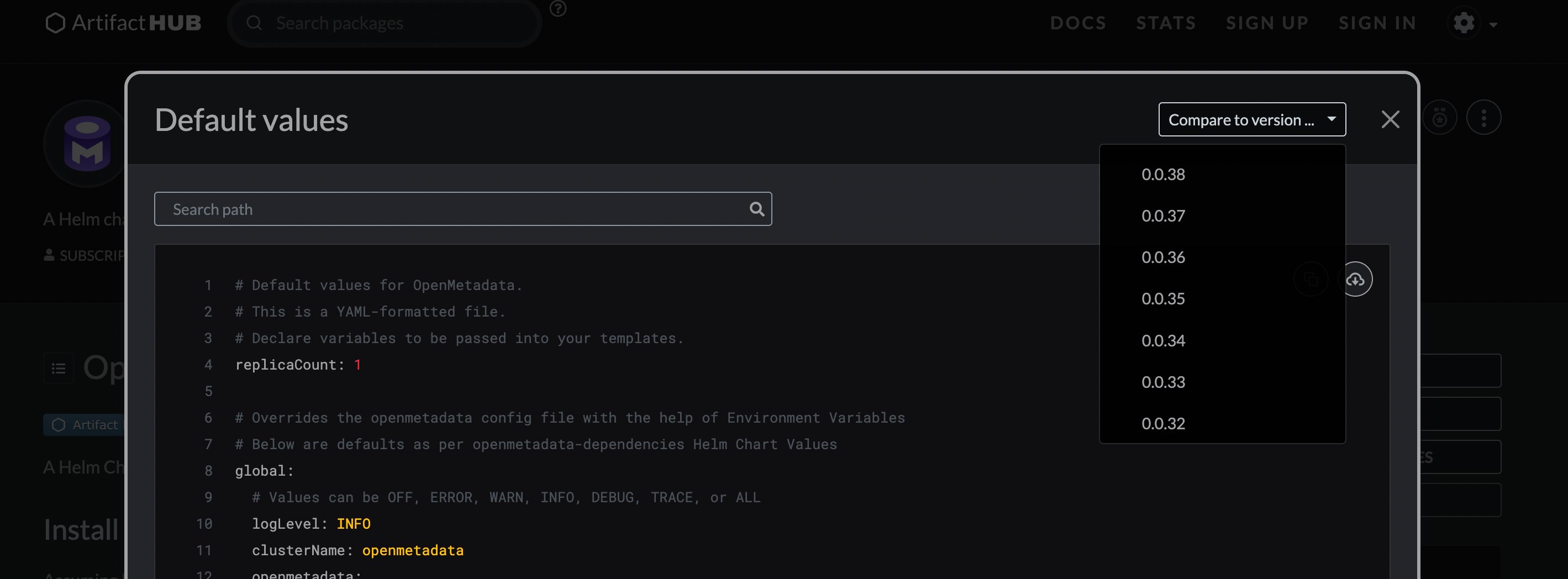
Step 2: Upgrade Helm Repository with a new release
Update Helm Chart Locally for OpenMetadata with the below command:Step 3: Upgrade OpenMetadata Dependencies
You can run the below command to upgrade the dependencies with the new chartvalues.yaml.
Step 4: Upgrade OpenMetadata
Finally, we upgrade OpenMetadata with the below command:values.yaml with the --values flag.
Note that in every version upgrade there is a migration process that updates your database to the newest version.
For kubernetes, this process will happen automatically as an upgrade hook.
Post-Upgrade Steps
Reindex
With UI
Go toSettings -> Applications -> Search Indexing
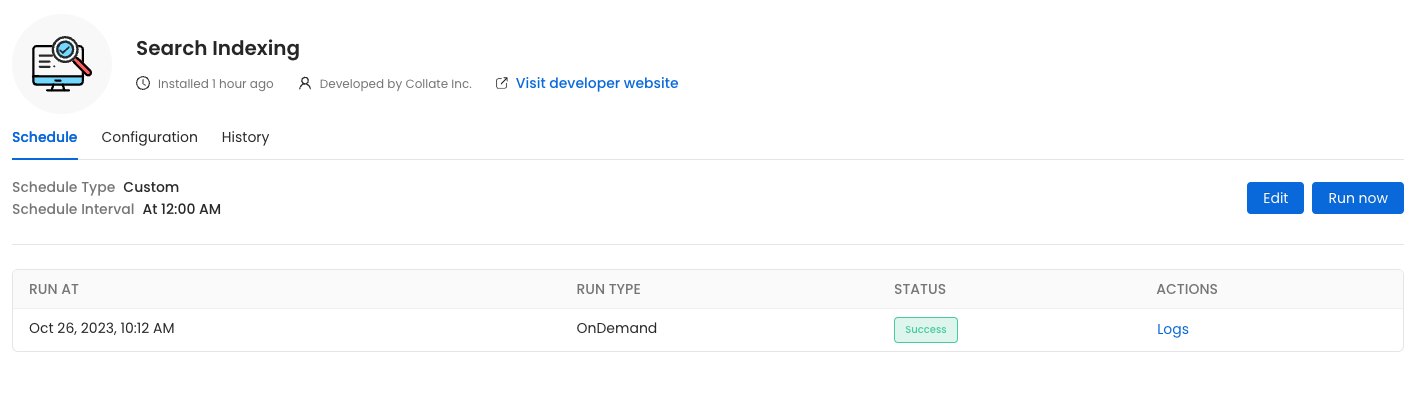
Run Now, ensure that the Recreate Indexes option is enabled to allow rebuilding the indexes as needed.
In the configuration section, you can select the entities you want to reindex.
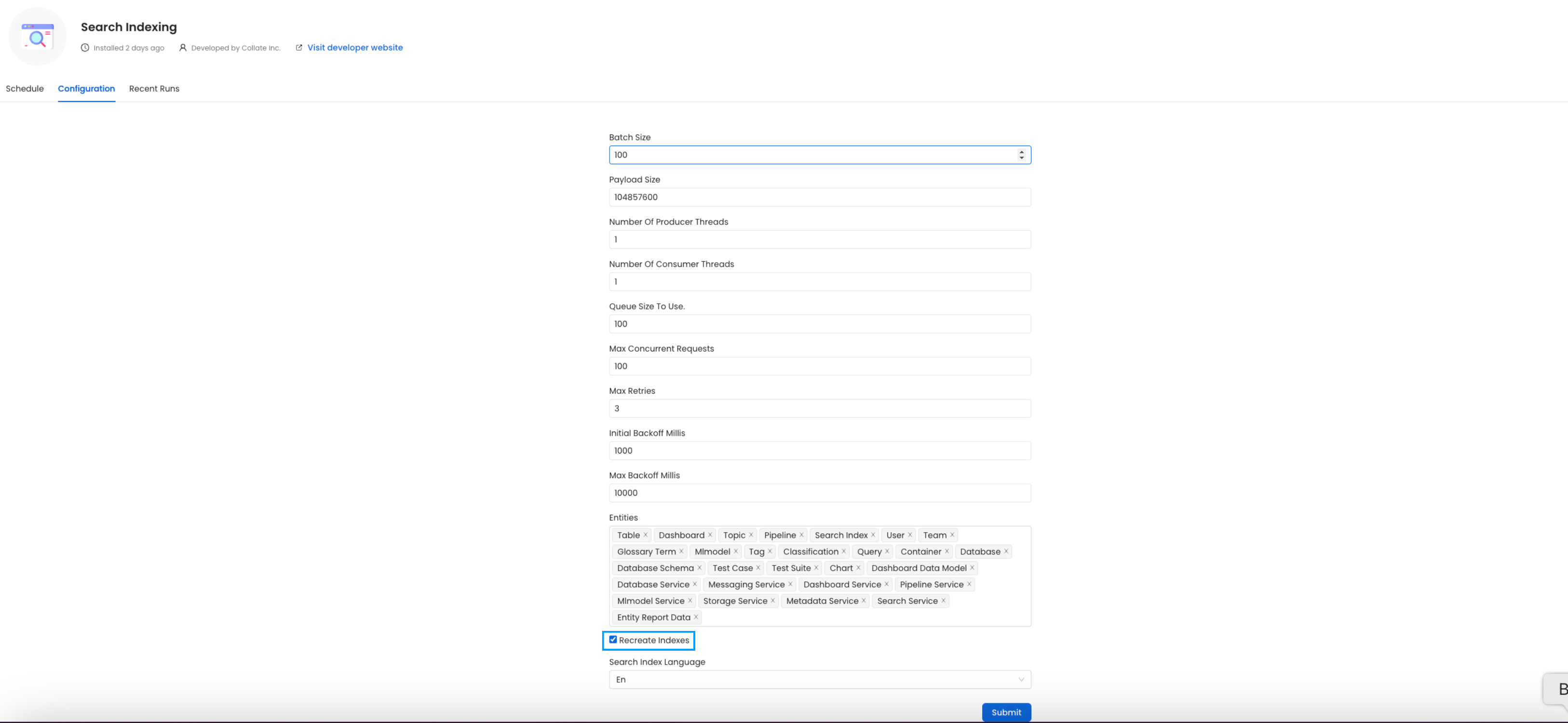
All the entities.
(Optional) Update your OpenMetadata Ingestion Client
If you are running the ingestion workflows externally or using a custom Airflow installation, you need to make sure that the Python Client you use is aligned with the Collate server version. For example, if you are upgrading the server to the versionx.y.z, you will need to update your client with
With Kubernetes
Follow these steps to reindex using the CLI:- List the CronJobs Use the following command to check the available CronJobs:
- Create a Job from a CronJob Create a one-time job from an existing CronJob using the following command:
- Check the Job Status Verify the status of the created job with:
- View logs To view the logs use the below command.
plugin parameter is a list of the sources that we want to ingest. An example would look like this openmetadata-ingestion[mysql,snowflake,s3]~=2.0.2.0.
You will find specific instructions for each connector here.
Moreover, if working with your own Airflow deployment - not the openmetadata-ingestion image - you will need to upgrade
as well the openmetadata-managed-apis version:
Re Deploy Ingestion Pipelines
With UI
Go toSettings -> {Services} -> {Databases} -> Pipelines
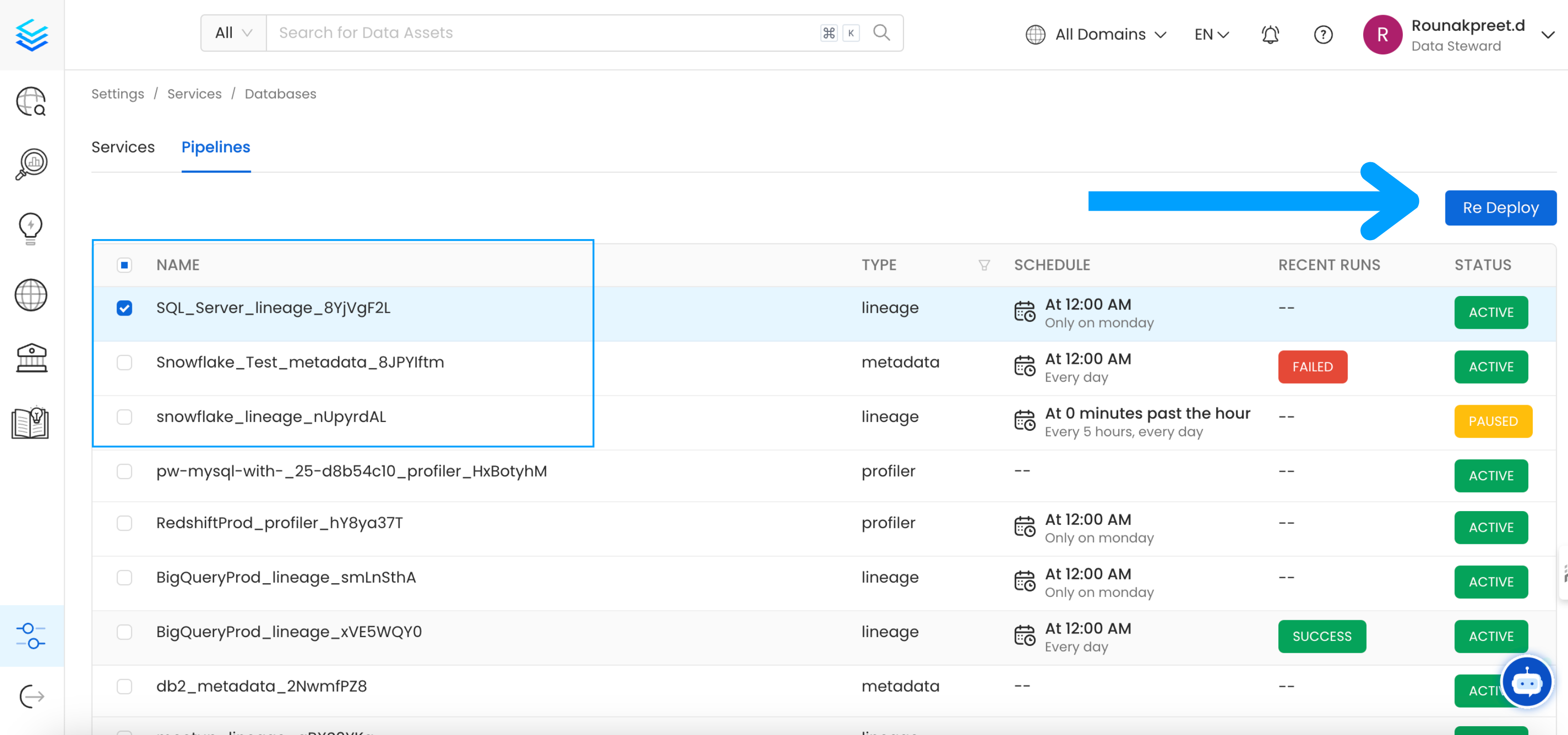
Re Deploy.
With Kubernetes
Follow these steps to deploy pipelines using the CLI:- List the CronJobs Use the following command to check the available CronJobs:
- Create a Job from a CronJob Create a one-time job from an existing CronJob using the following command:
- Check the Job Status Verify the status of the created job with:
- view logs To view the logs use the below command.
OpenMetadata Ops Script
Overview
Theopenmetadata-ops script is designed to manage and migrate databases and search indexes, reindex existing data into Elastic Search or OpenSearch, and redeploy service pipelines.
Usage
Commands
- analyze-tables
- changelog
- check-connection
- deploy-pipelines
- drop-create
- info
- migrate
- migrate-secrets
- reindex
- repair
- validate
Examples
Display Help To display the help message:Migrate Database Schema
To migrate the database schema and search index mappings:Reindex Data
To reindex data into the search engine:Troubleshooting
Helm Upgrade fails with additional property airflow not allowed
With Release 1.0.0, if you see your helm charts failing to deploy with the below issue -global.airflow. Airflow configs are replaced with pipelineServiceClient for Helm Charts.
The Helm Chart Values JSON Schema helps to catch the above breaking changes and this section will help you resolve and update your configurations for the same. You can read more about JSON Schema with Helm Charts here.
You will need to update the existing section of global.airflow values to match the new configurations.
⛔ Before 1.0.0 Helm Chart Release, the global.airflow section would be like -
global.pipelineServiceClient section will replace the above airflow section -
MySQL Pod fails on Upgrade
If your helm dependencies upgrade fails with the below command result -8.0.28 to 8.0.29 for the Helm Chart Release 0.0.49 and 0.0.50. Then the registry url was updated as we found a work around to fetch previous versions of bitnami/mysql Helm Releases.
As a result of the above fixes, anyone who is on OpenMetadata Dependencies Helm Chart Version 0.0.49 and 0.0.50 is affected with the above issue when upgrading for mysql. In order to fix this issue, make sure to follow the below steps -
- Backup the Database using Metadata Backup CLI as mentioned here
- Uninstall OpenMetadata Dependencies Helm Chart (
helm uninstall openmetadata-dependencies) - Remove the unmanaged volume for MySQL Stateful Set Kubernetes Object (
kubectl delete pvc data-mysql-0) - Install the latest version of OpenMetadata Dependencies Helm Chart
- Restore the Database using Metadata Restore CLI as mentioned here
- Next, Proceed with upgrade for OpenMetadata Helm Chart as mentioned here