
- Requirements
- Entity Mapping
- Metadata Ingestion
- Enable Security
- Lineage
- Troubleshooting
- Reverse Metadata
Requirements
To ingest Tableau metadata, minimumSite Role: Viewer is required for the Tableau user.
To create lineage between Tableau dashboards and any database service via the queries provided from Tableau Metadata API, enable the Tableau Metadata API for your Tableau server.
For more information, see Get Started with the Metadata API.
Source Tables and Lineage
Grant the ingestion account View on the affected external assets in Tableau Catalog, or use an account that already holds it. A Viewer or Explorer site role alone is not enough for Collate to build table lineage. For the steps, see Manage Permissions for External Assets in the Tableau documentation.Entity Mapping
The Tableau connector maps Tableau assets to Collate entities as follows:Example Structure
Tableau Structure:- Tableau workbooks appear as Collate dashboards.
- All views (worksheets, dashboard views, stories) appear as charts under that dashboard.
- Tableau project names are preserved in the project field.
- URLs point directly to the specific views.
Metadata Ingestion
To ingest metadata from Tableau, you need to create a service connection. The service connects Tableau with Collate. Once you create a service, Collate automatically starts ingesting metadata.Step 1: Add New Service
Open the Services page and start a new service.-
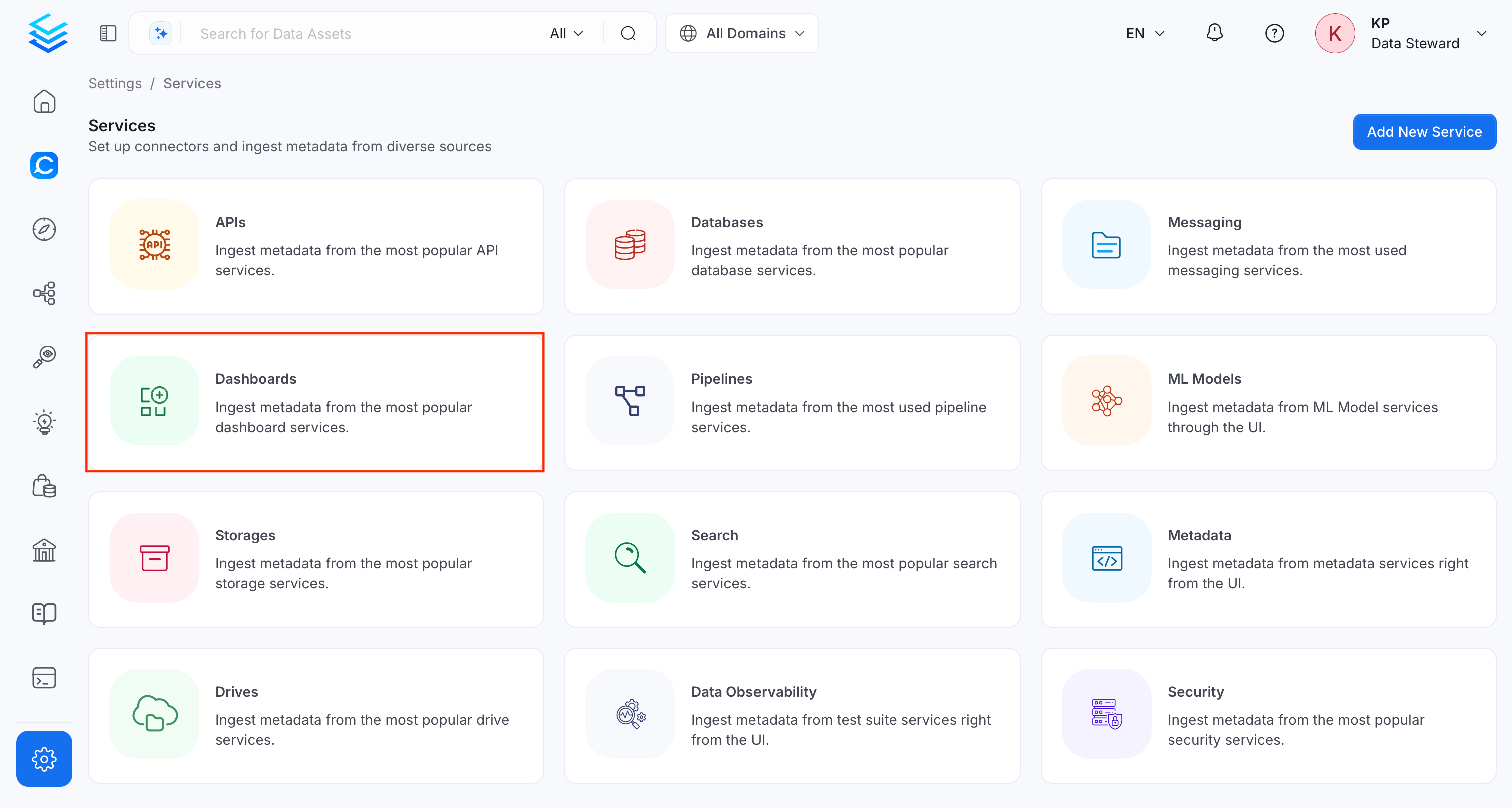
Navigate to Settings > Services and select Dashboard Services.
-
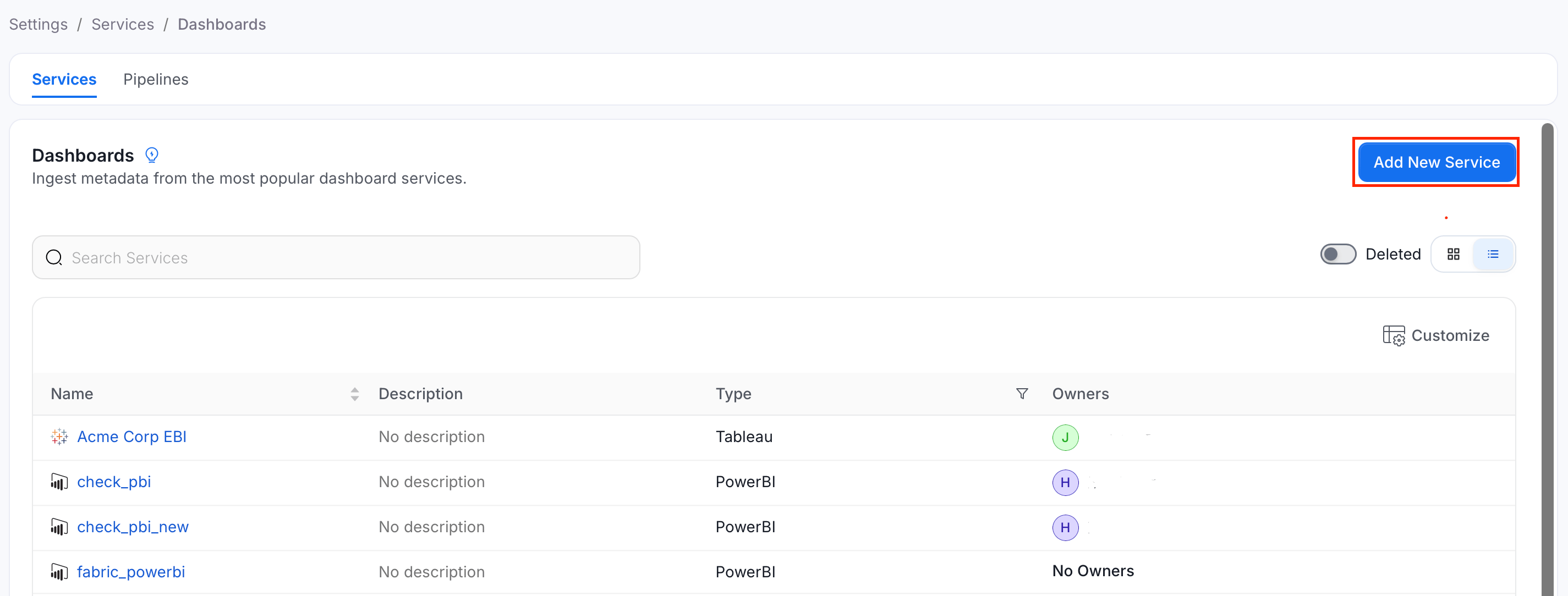
Click Add New Service.
Step 2: Select a Service and Connector
From the service type dropdown, select Dashboard Services, then click the Tableau connector tile.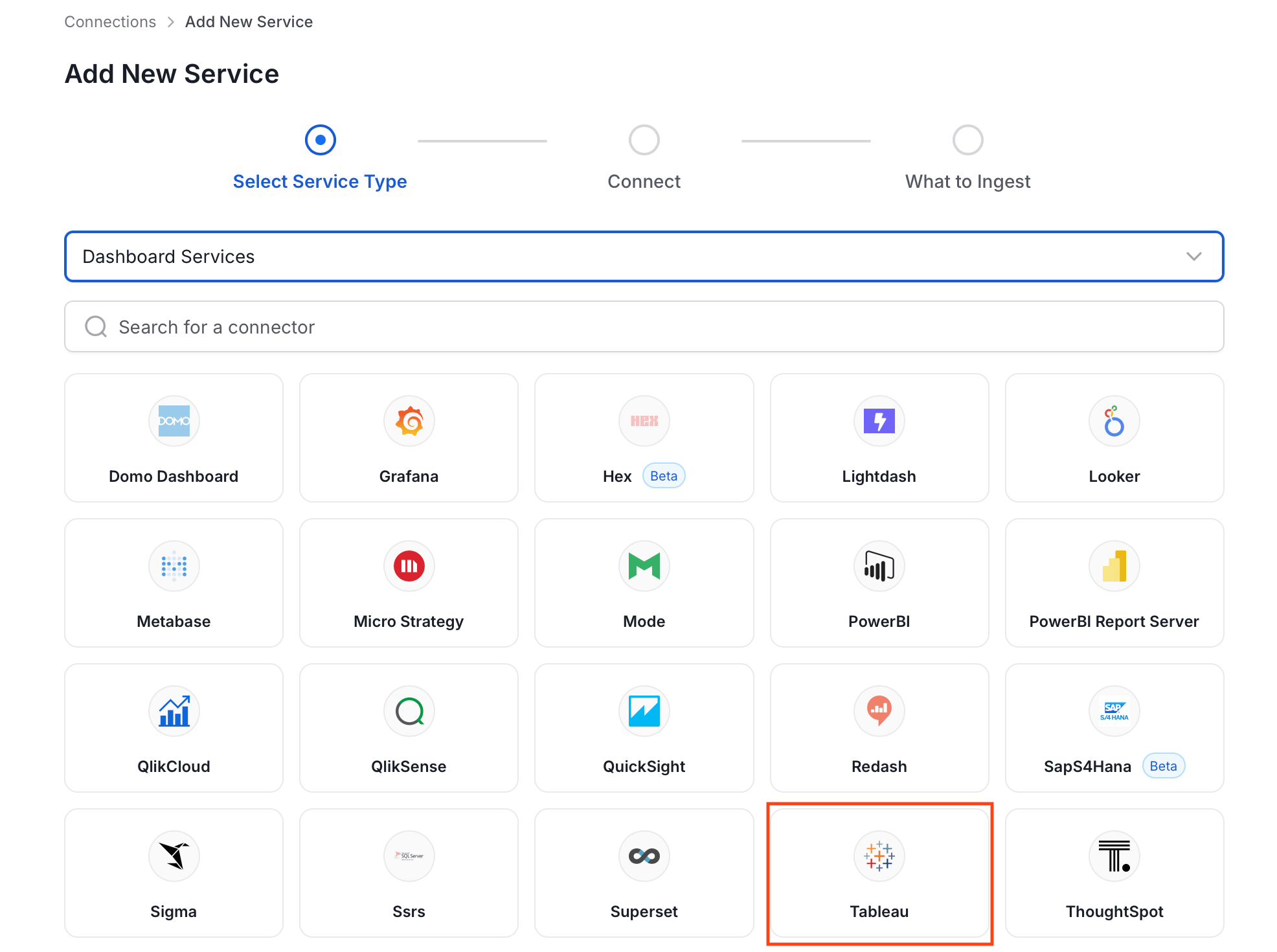
Step 3: Add Service Name and Description
- Enter a unique, descriptive Service Name. Collate identifies services by their service name. Enter a name that distinguishes this deployment from other Tableau services you are ingesting metadata from.
- Optional: Enter a Description for the service.
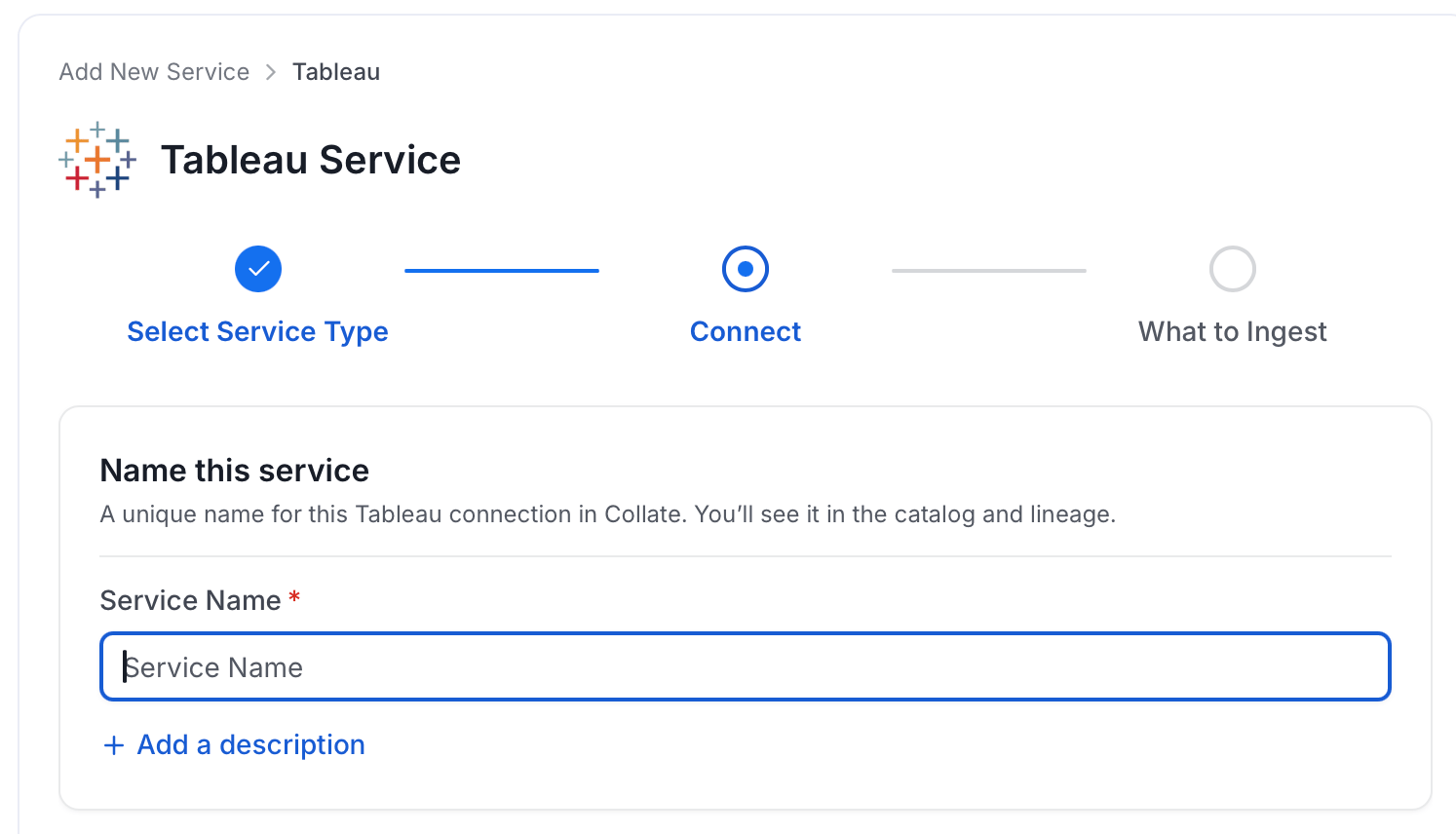
Note: The service name can’t be changed after you set it.
Step 4: Configure Connection Options
Specify where ingestion runs, provide your source credentials, and verify the connection.Select Ingestion Runner
Select an Ingestion Runner: the runner where the ingestion pipeline will execute.
Enter Connection Details
Enter the connection details for Tableau. The right-hand panel in the UI displays inline help for each field.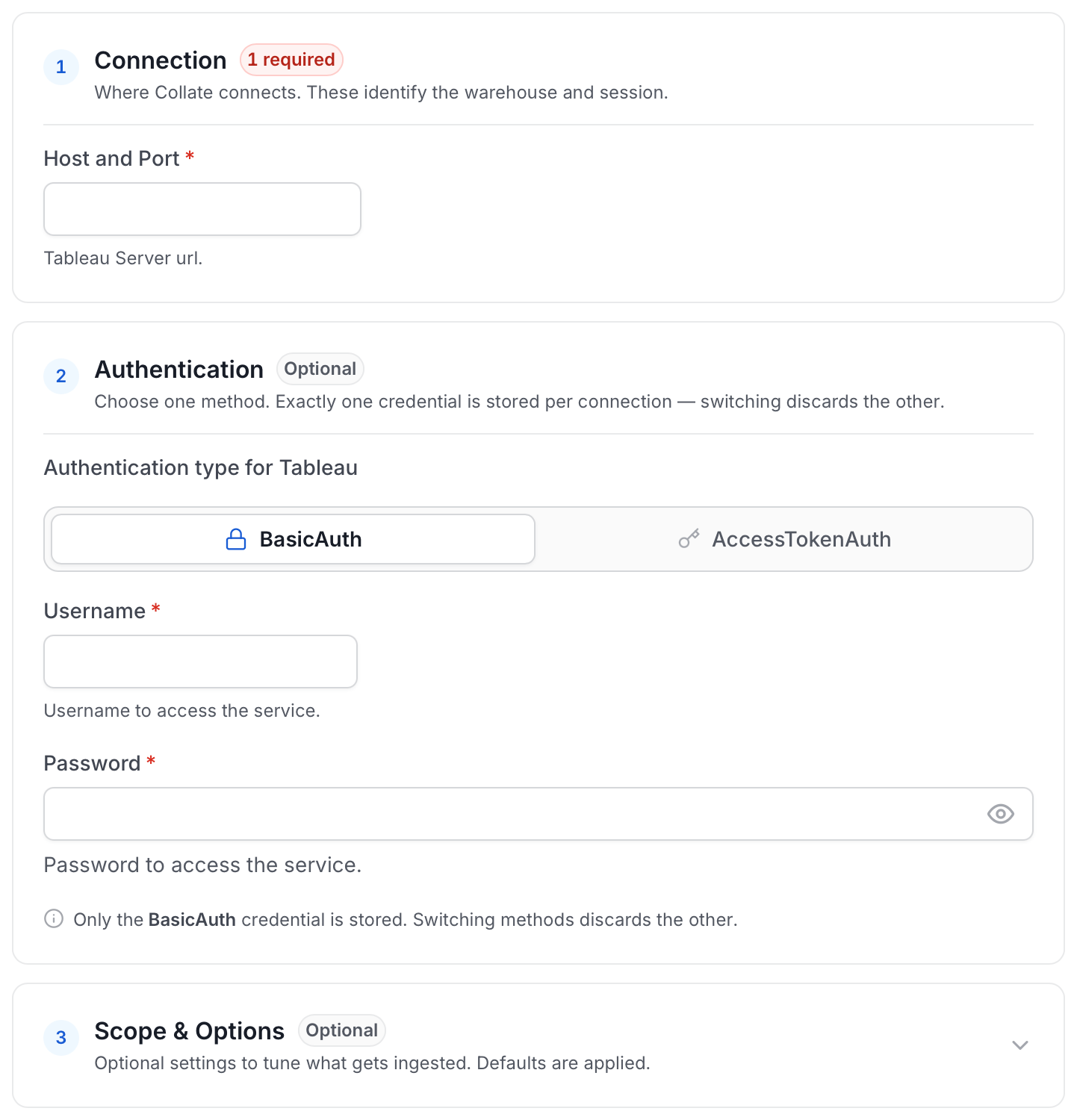
- Host and Port: URL or IP address of your installation of Tableau Server.
- Authentication Types:
- Basic Authentication
- Username: The name of the user whose credentials will be used to sign in.
- Password: The password of the user.
- Access Token Authentication
- Personal Access Token: The personal access token name. For more information, see Personal Access Tokens.
- Personal Access Token Secret: The personal access token value. For more information, see Personal Access Tokens.
- API Version: Tableau API version. For a list of Tableau Server versions and their corresponding REST API and REST API schema versions, see REST API Versions.
- Site Name: This corresponds to the
contentUrlattribute in the Tableau REST API. Thesite_nameis the portion of the URL that follows the/site/in the URL. - Site URL: If it is empty, the default Tableau site name will be used.
- Environment: The config object can have multiple environments. The default environment is defined as
tableau_prod, and you can change this if needed by specifying anenvparameter. - Pagination Limit: The pagination limit will be used while querying the Tableau Graphql endpoint to get the data source information.
Site Name and Site URL
TheSite Name and Site URL fields behave differently depending on how your Tableau instance is deployed.
1. Service Connection for Tableau Cloud
If you’re connecting to a cloud Tableau instance, add theSite Name and Site URL with your site name.
2. Service Connection for a Default Tableau Site
For a default Tableau site, theSite Name and Site URL fields should be kept empty.
3. Service Connection for a Non-Default Tableau Site
For a non-default Tableau site, theSite Name and Site URL fields are required.
Authentication Type
Tableau supports two authentication methods for the connector.1. Basic Authentication
Basic authentication requires the username and password of the user signing in.2. Access Token Authentication
Access token authentication requires the personal access token name and the personal access token value. For more information, see Personal Access Tokens.Test Connection
- Click Test Connection to verify the credentials.
- After the test succeeds, click Save.

Step 5: Configure Ingestion Options
In the What to Ingest step, use filter patterns to control which assets Collate ingests from your dashboard service. Filter rules match asset names using the following match types.How Filter Patterns Work
- Include: Add one or more comma-separated values. Each value uses one of the following match types. Collate ingests only assets whose names match at least one rule. Leave blank to include all assets.
- Exclude: Add one or more comma-separated values. Each value uses one of the following match types. Collate skips any asset whose name matches a rule. Leave blank to exclude nothing.
- contains: matches any name containing the value. For example,
salesmatchesmy_sales_dataandsales_2024. - starts with: matches names beginning with the value. For example,
prod_matchesprod_dbandprod_schema. - ends with: matches names ending with the value. For example,
_rawmatchesevents_rawandlogs_raw. - is exactly: matches the exact name only. For example,
analyticsmatches onlyanalytics. - matches regex: matches names using a regular expression. For example,
^prod_.*_v\d+$matchesprod_events_v1.
Filter Options
The Dashboard and Chart sections each include the following filter options:- Dashboard: Controls which dashboards Collate ingests from the source.
- Chart: Controls which charts within the ingested dashboards are included.
- Scan Mode: Choose between the following scan modes:
- Scan all: Ingests every asset of that type the connector can access. This is the default.
- Only specific: Enables include rules so only assets matching at least one rule are ingested.
- Exclude system toggle: Use this toggle to filter out system-reserved names defined by the connector for that asset type.
- Always exclude: Add permanent exclusion rules (shown in red). Assets matching these rules are never ingested, regardless of include rules.
- Preview: Shows a real-time summary of what will be in scope based on your current rules.
- Include rules: In Only specific mode, click + Add to define a rule. Added rules appear as chips. An asset is included if it matches any rule.
Step 6: Create & Deploy
Click Create & Deploy to deploy the agent and start the first metadata ingestion run. Collate saves the service configuration and immediately begins pulling metadata from the source. To monitor ingestion progress or view the service you just added, go to Settings > Services and select your service.Configure Metadata Agent and Schedule Ingestion
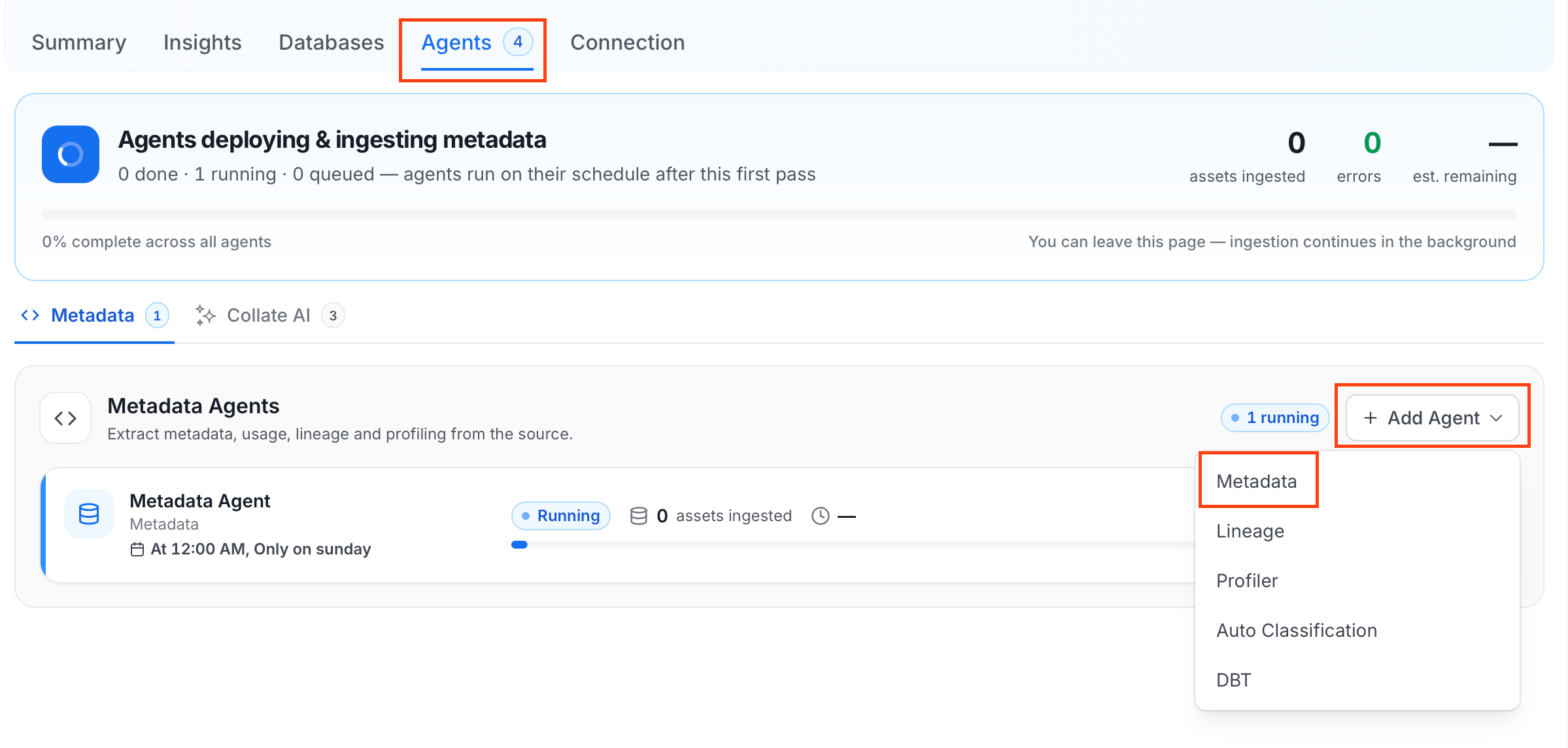
The Metadata Agent extracts dashboards, charts, data models, and other structural metadata from your source and keeps your Collate catalog in sync. It powers discovery, lineage, and governance across your data assets. When you click Create & Deploy, Collate automatically deploys a Metadata Agent for this service and triggers the first ingestion run. View its status and run history from the Agents tab on the service detail page. To configure the additional Metadata Agent and schedule ingestion, follow these steps:- Navigate to Settings > Services and select the Dashboards service.
- Select your service and click the Agents tab.
-
Click Add Agent and select Metadata from the dropdown.
-
On the Configure Ingestion page, do the following and click Next.
-
Name this Ingestion: Enter a unique, recognizable name for this ingestion pipeline.

-
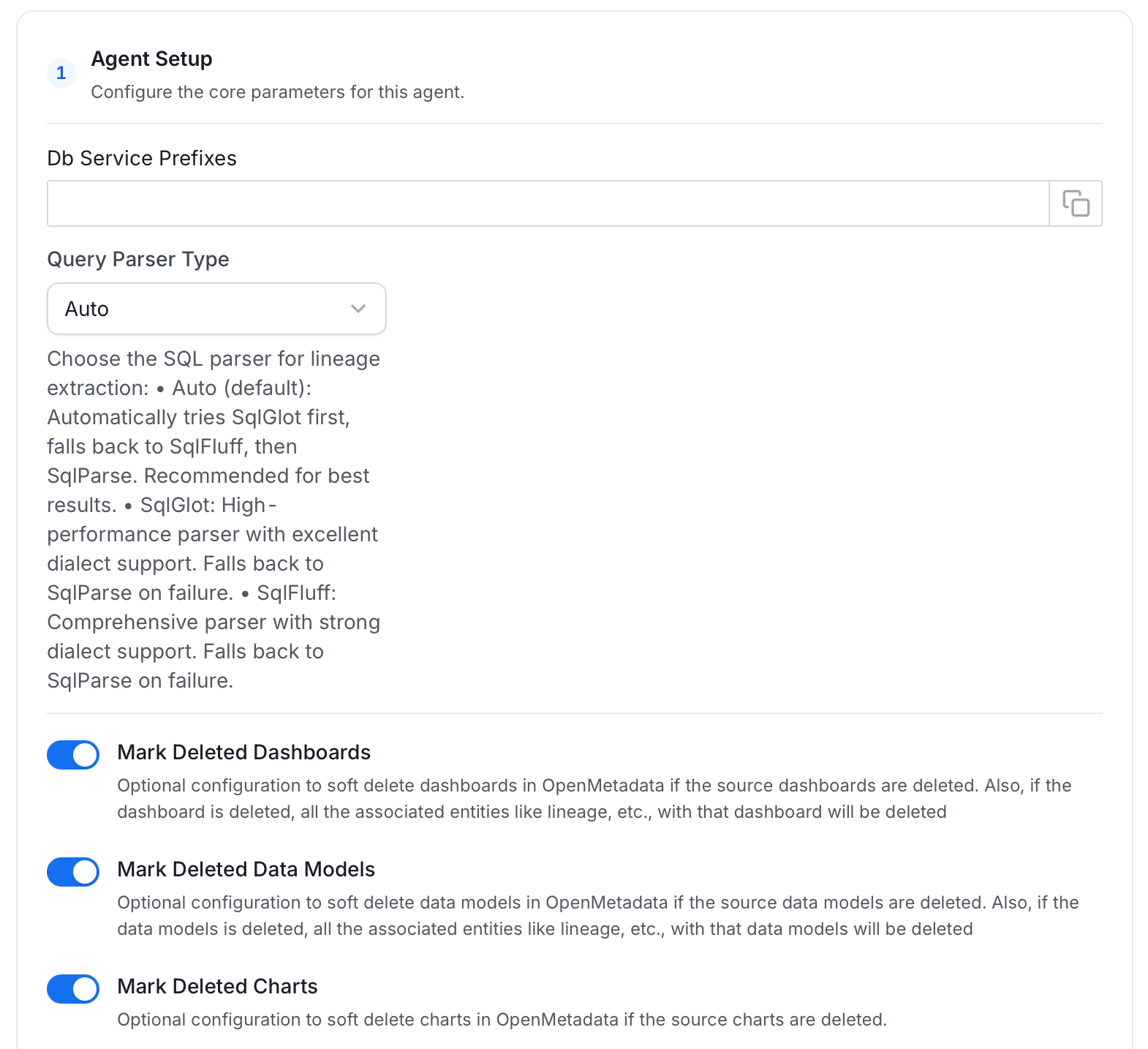
Agent Setup: Configure ingestion parameters. The following fields are available:
-
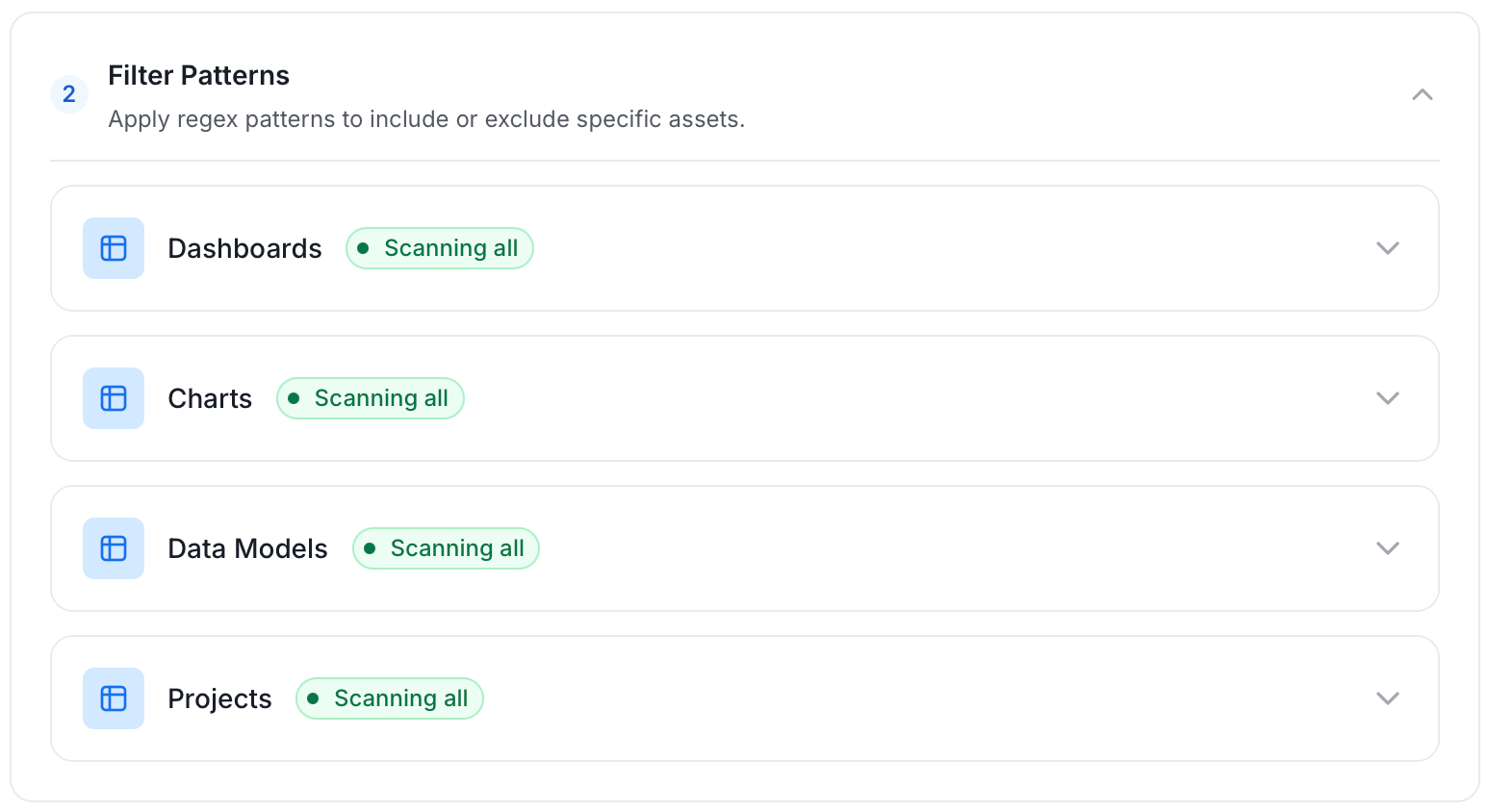
Filter Patterns: Apply include or exclude rules to scope which dashboards, charts, data models, and projects this agent ingests. These follow the same filter options described in Step 5.
-
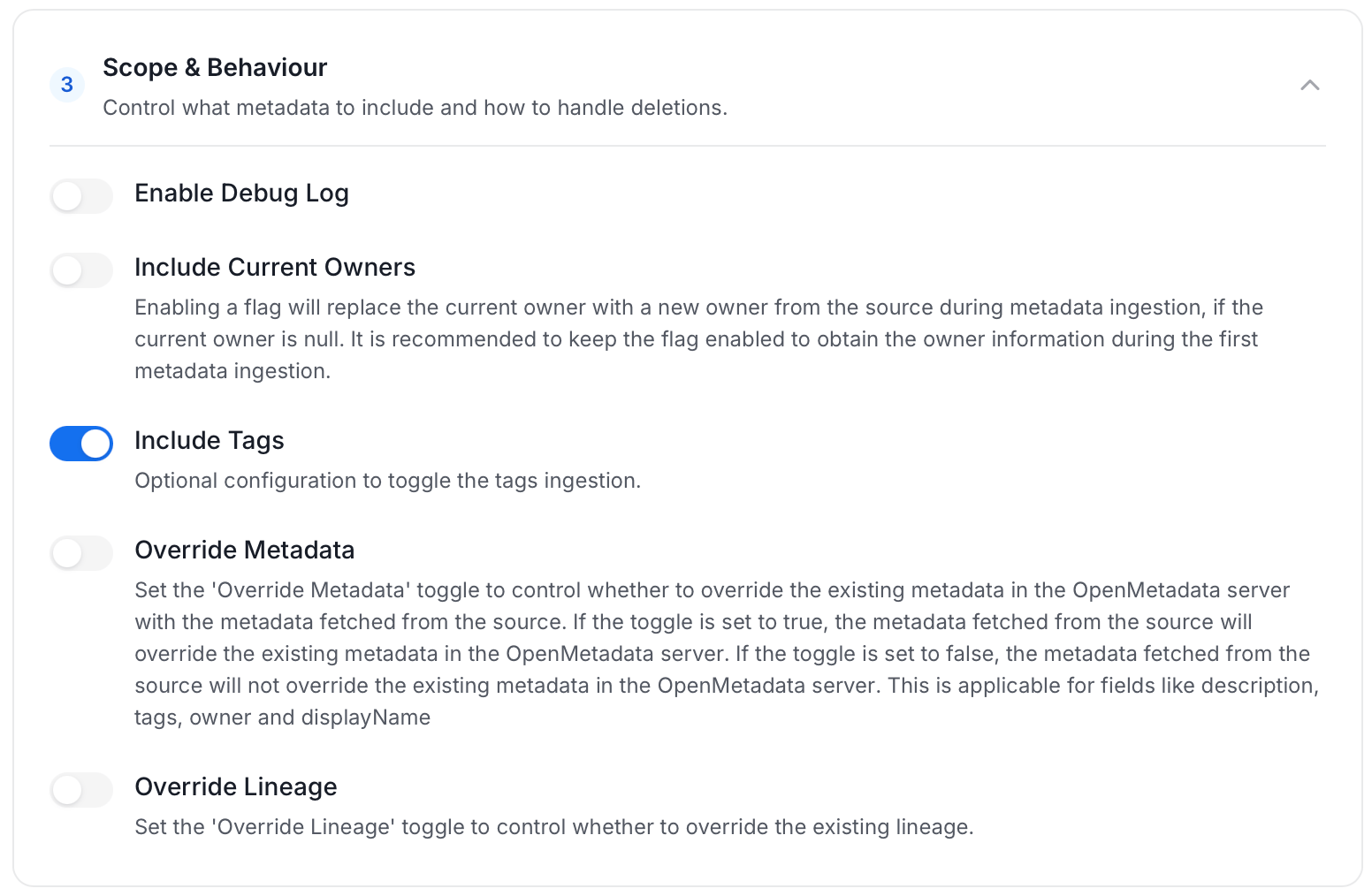
Scope & Behaviour: Control what metadata to include and how to handle deletions. Toggle each option on or off based on your needs:
-
Name this Ingestion: Enter a unique, recognizable name for this ingestion pipeline.
-
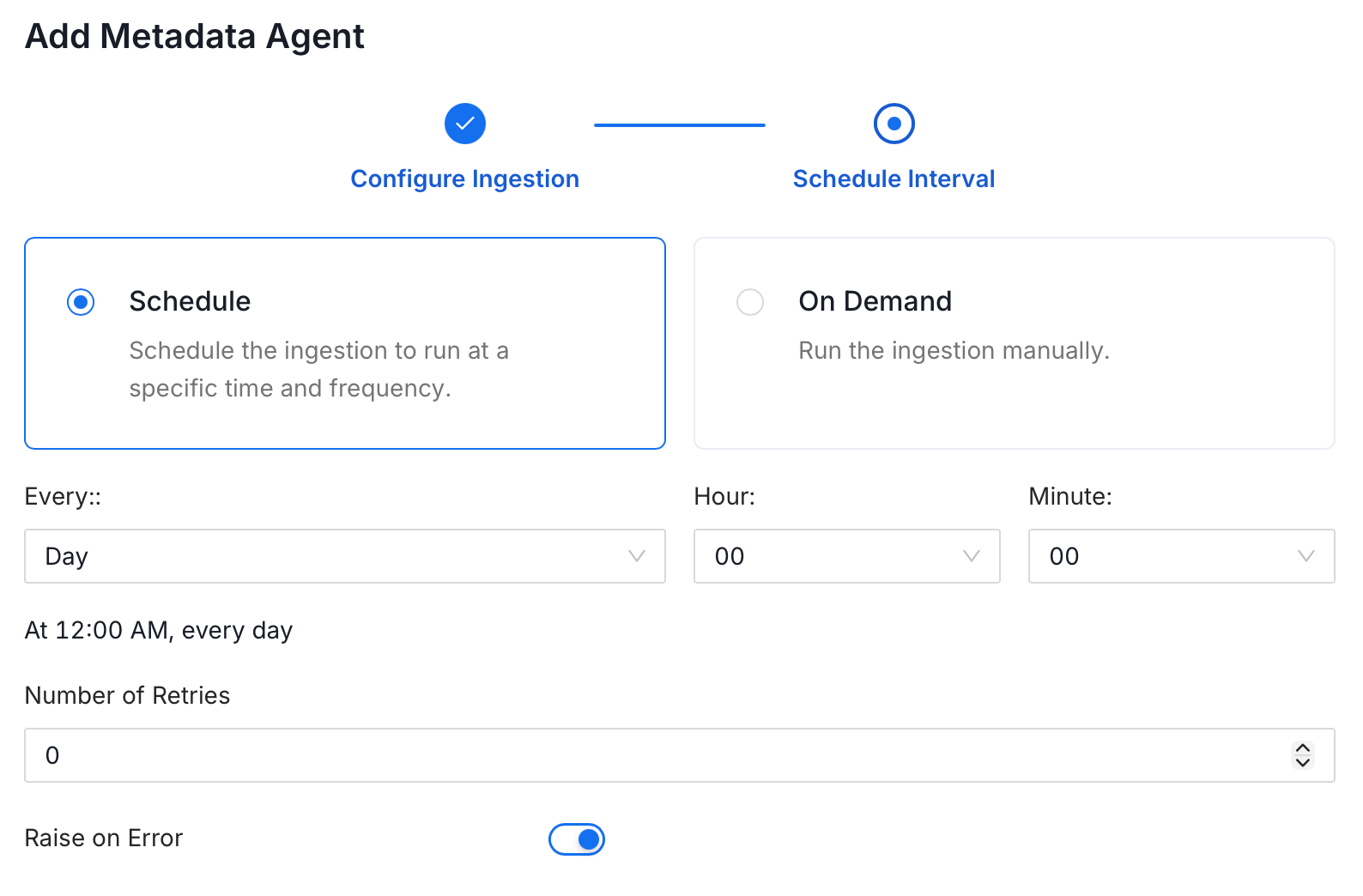
On the Schedule Interval page, set when the agent runs:
- Schedule: Choose a preset interval (Hourly, Daily, Weekly, Monthly) or enter a custom cron expression.
- On-Demand: No automatic schedule. Trigger the agent manually when needed.
- Click Add to deploy the agent.
Lineage
Lineage
Lineage in Collate shows you which database tables power each dashboard. When lineage is set up, you can trace any dashboard back to the exact source tables in your database. There is no separate lineage agent or lineage pipeline—lineage is collected as part of the same metadata ingestion workflow. Configuring the Db Service Prefixes field (covered below) is optional but recommended — it restricts table matching to specific database services. If left blank, Collate attempts to match source tables across all ingested database services.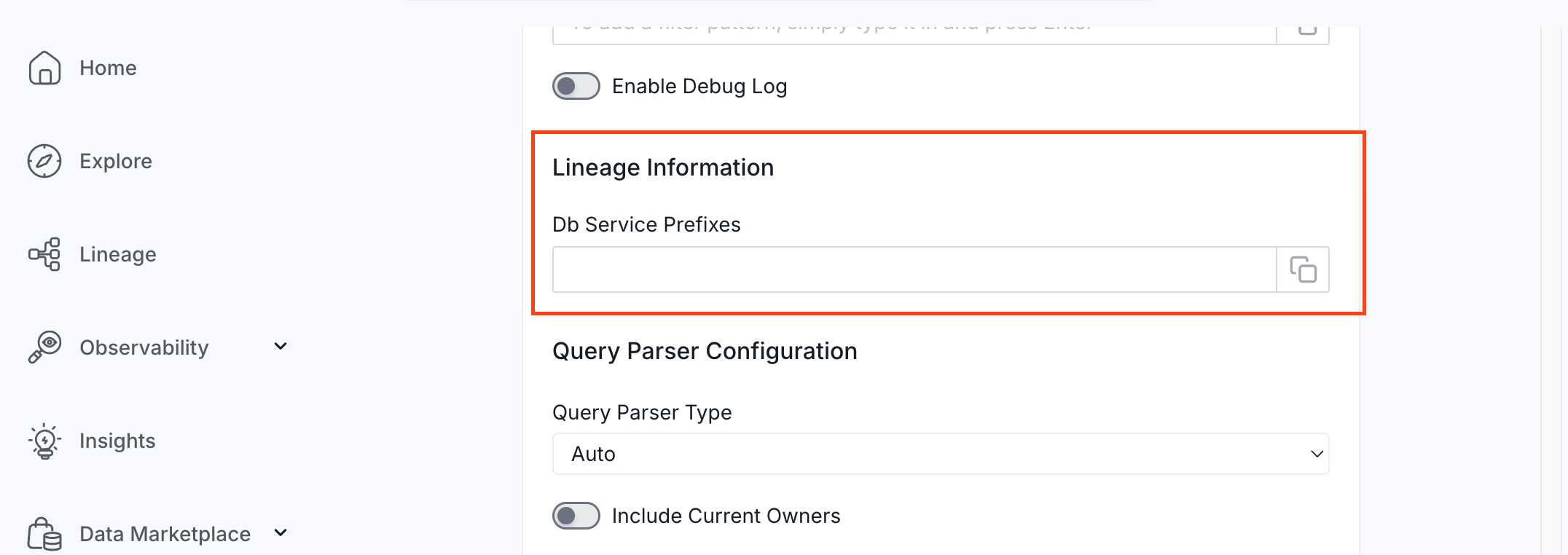
How to Set Up Lineage
- Go to Settings > Services > Dashboards.
- Click the dashboard service you’ve added.
- Go to the Agents tab, then select Add Agent > Add Metadata Agent. If a metadata agent already exists, select the three-dot context menu (⋮) next to it and select Edit.
- In the Configure Ingestion step, scroll down to the Lineage Information section.
- Optionally enter one or more database service names in the Db Service Prefixes field to restrict table matching to specific services. If left blank, Collate searches across all ingested database services.
Securing Tableau Connection with SSL in Collate
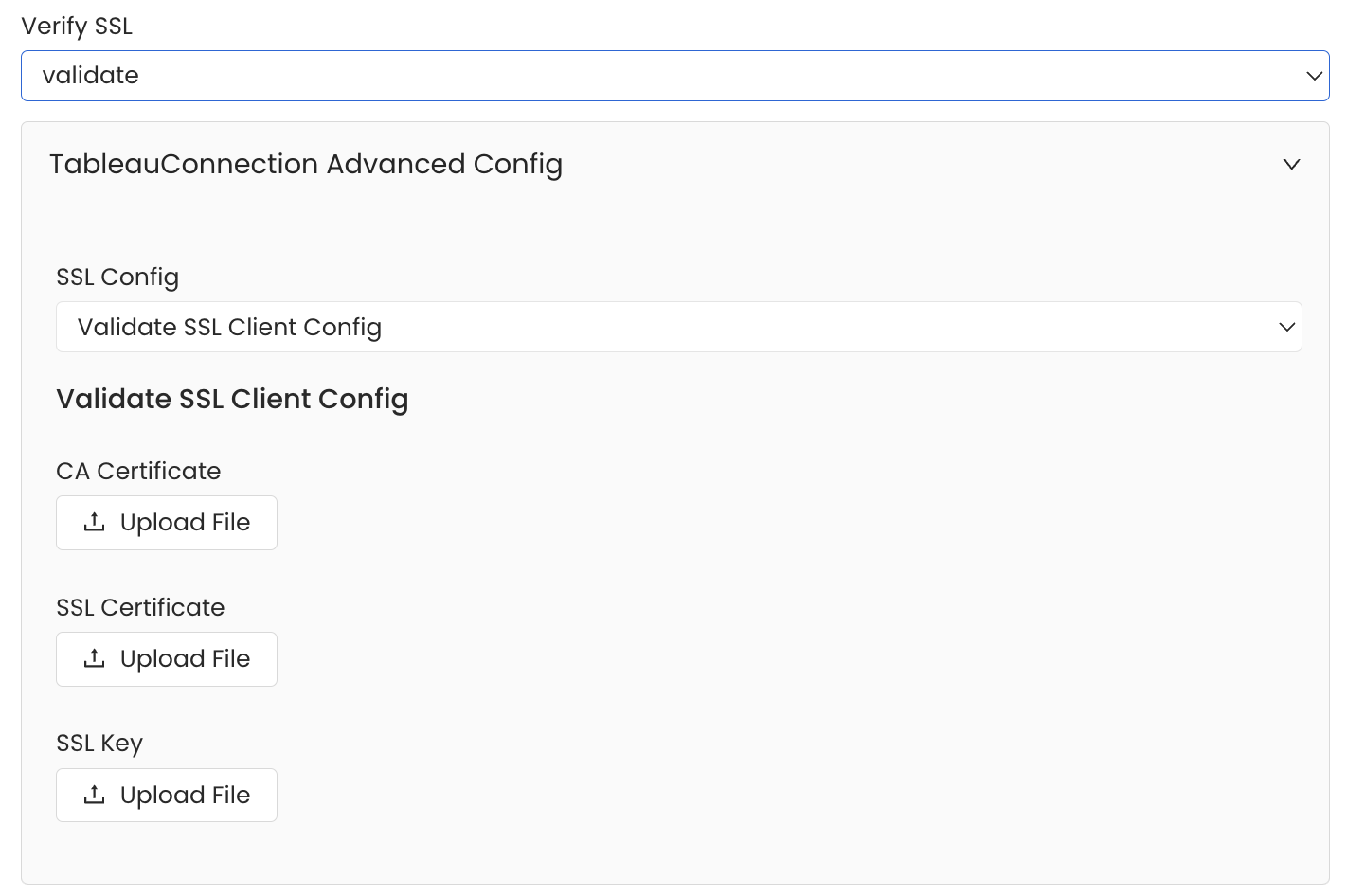
To establish secure connections between Collate and Tableau, navigate to theAdvanced Config section. Here, you can provide the CA certificate used for SSL validation by specifying the caCertificate. Alternatively, if both client and server require mutual authentication, you’ll need to use all three parameters: ssl_key, ssl_cert, and caCertificate. In this case, ssl_cert is used for the client’s SSL certificate, ssl_key for the private key associated with the SSL certificate, and caCertificate for the CA certificate to validate the server’s certificate.
Troubleshooting
Tableau Troubleshooting
Learn more about how to troubleshoot common Tableau connector issues and resolve configuration or ingestion errors.
Reverse Metadata
Reverse Metadata
Description Management
Tableau supports description updates at the following levels:- Dashboard level
- Chart level
Owner Management
Tableau supports owner management at the following levels:- Dashboard level
Tag Management
Tableau supports tag management at the following levels:- Dashboard level
- Chart level