> ## Documentation Index
> Fetch the complete documentation index at: https://docs.getcollate.io/llms.txt
> Use this file to discover all available pages before exploring further.
# Breaking Changes - Collate AI & Credits | Official Documentation
> Conversation sharing and collaborators, the reworked weighted credit model, the redesigned billing pages and the Query Runner changes in Collate 2.0.
# Collate AI & Credits
## AskCollate is renamed to Collate AI
**Breaking for anything that matches on the product name.** AskCollate is renamed to **Collate AI**
everywhere: the UI, the backend, billing labels, chat prompts, and the Slack and Microsoft Teams
integrations.
Update saved searches, dashboards, runbooks, alert rules and Slack/Teams workflow triggers that match
on the string `AskCollate`. Billing exports change label too, so any spreadsheet or BI report keyed on
the old label needs repointing.
Conversations also become collaborative, and the credit model changes from a flat token count to a
weighted, cache-aware calculation.
## Credits are now weighted
**Behavioural.** The same workload consumes a different number of credits in 2.0 than in 1.13.
1.13 charged credits from a flat token count. 2.0 introduces a weighted, cache-aware model:
| Change | Effect |
| -------------------------------- | ------------------------------------------------------------------------------------------------------------------------------------------------------------------------------- |
| **Weighted by token type** | Input, output, cache-read and cache-write tokens carry different cost ratios, so a cache-heavy conversation costs materially less than the same token count of fresh generation |
| **Weighted by model** | Credits are weighted by the model that actually served each call, so a request routed to a cheaper model costs fewer credits |
| **Fixed divisor** | The weighted basis is divided by a locked `tokensPerCredit` of 58,000 |
| **Cache-only usage is recorded** | Lump-sum recording is guarded on the weighted basis so cache-only usage is no longer silently dropped |
| **Per-conversation attribution** | Credits are attributed to the conversation that spent them, not just to the tenant pool |
If you forecast spend from 1.13 token counts, re-baseline after upgrading. Re-run a representative
week and compare, rather than converting the old numbers.
### Runs that cannot finish are refused
**Behavioural.** 2.0 warns before the credit limit is reached and **refuses to start work that
cannot complete** within the remaining pool.
In 1.13 a long automation could start and exhaust the pool part-way through, leaving partial results and no credits. In 2.0 the run is rejected up front with a clear reason.
Operators get a live view of the pool at `GET /v1/status/credits`, and credits can be refunded from
the operator API.
## Billing is redesigned
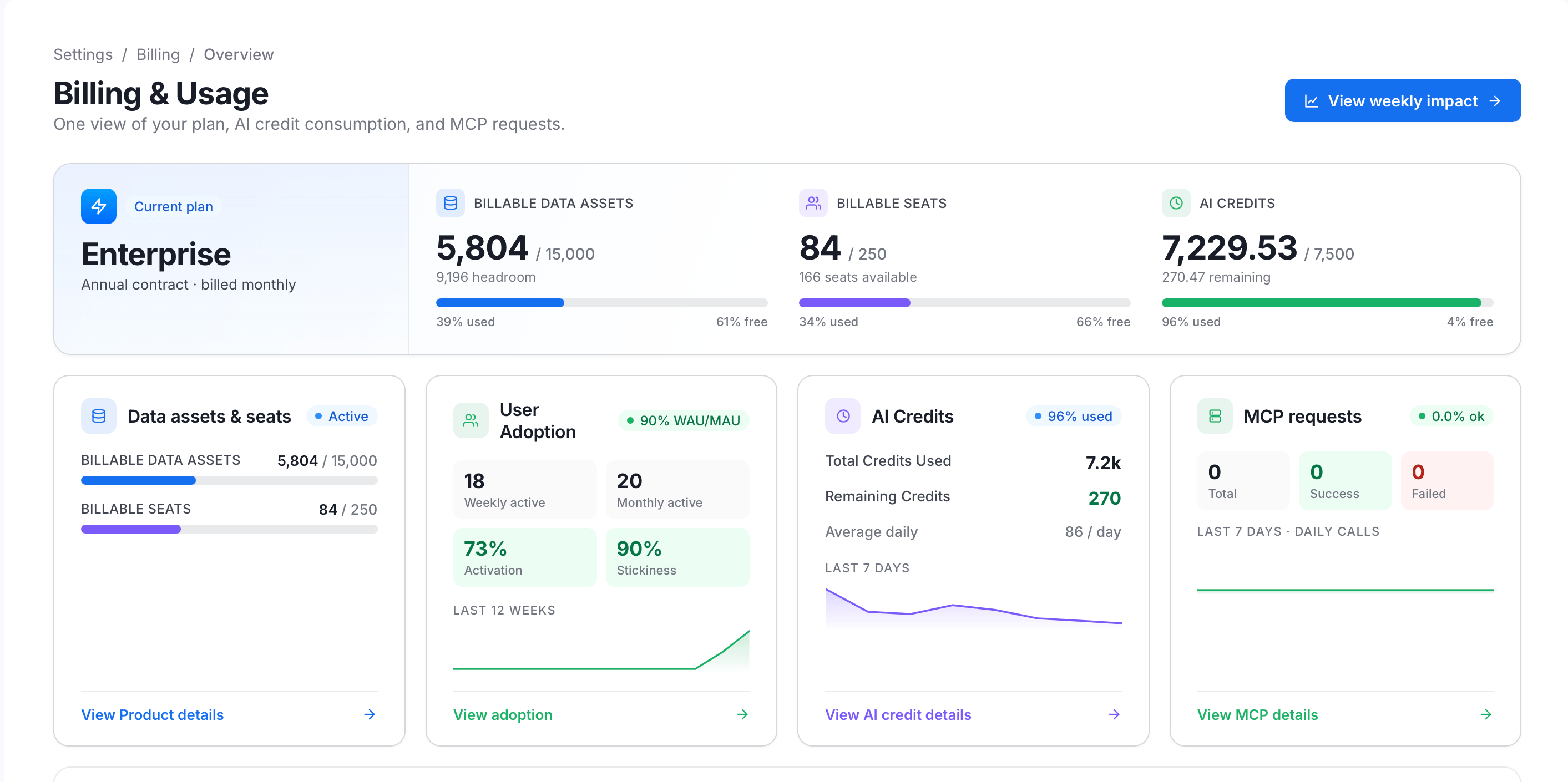
The **Billing** area is reorganised into **Overview**, **Product**, **User Adoption**, **AI Credits**, and **MCP requests**.
 | New endpoint | Purpose |
| -------------------------------------------- | ----------------------------------------------------- |
| `GET /v1/billing/credits/conversations` | Per-conversation credit consumption, paginated |
| `GET /v1/billing/adoption/users` | Per-user adoption |
| `GET /v1/billing/weekly-impact` | Weekly impact digest data |
| `POST /v1/billing/weekly-impact/send-digest` | Send the digest, with a date-aware subject and header |
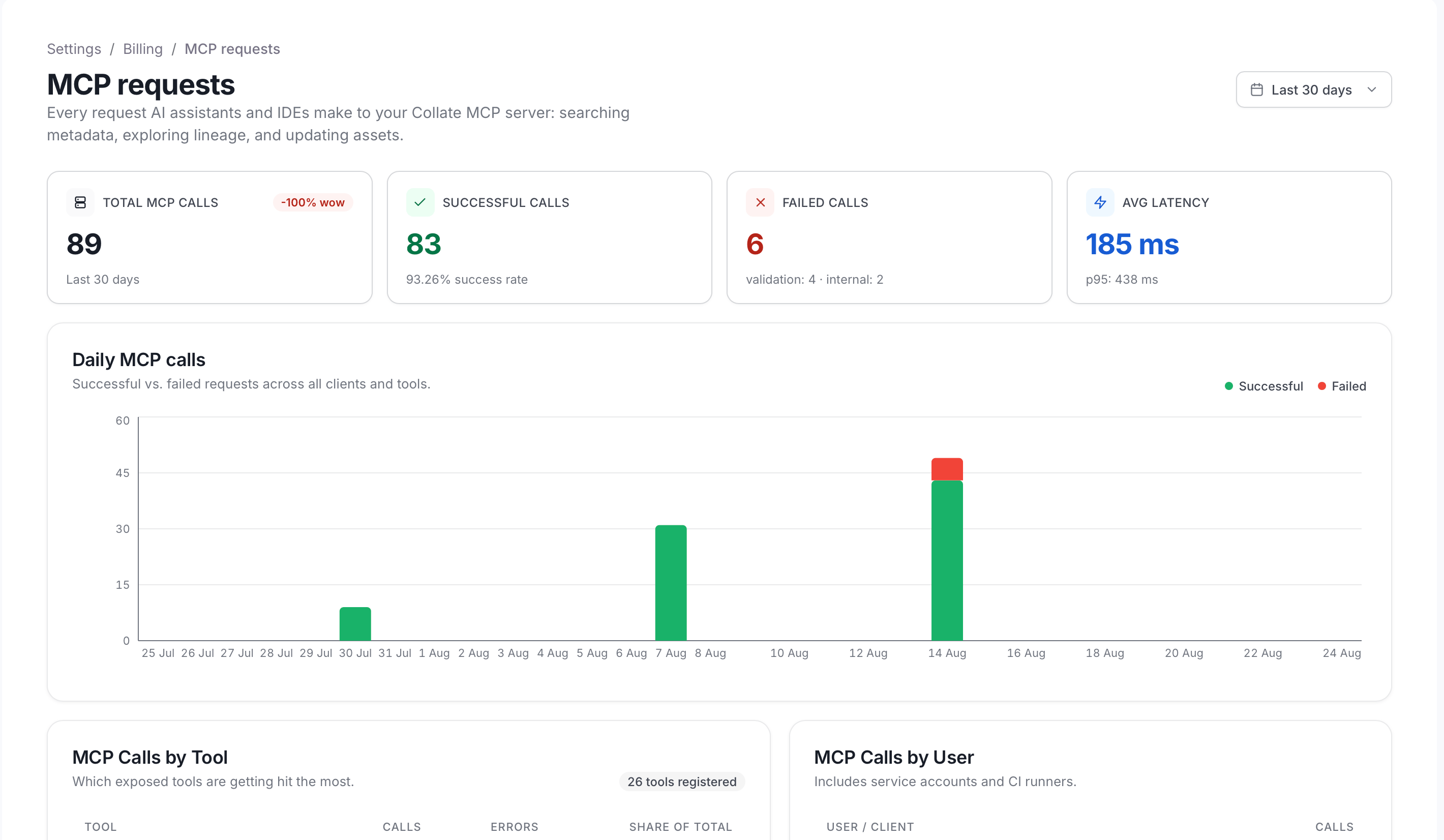
An **MCP requests** usage section is added, backed by a daily MCP usage rollup in the telemetry payload, and AI chat response time is now measured server-side rather than in the browser.
| New endpoint | Purpose |
| -------------------------------------------- | ----------------------------------------------------- |
| `GET /v1/billing/credits/conversations` | Per-conversation credit consumption, paginated |
| `GET /v1/billing/adoption/users` | Per-user adoption |
| `GET /v1/billing/weekly-impact` | Weekly impact digest data |
| `POST /v1/billing/weekly-impact/send-digest` | Send the digest, with a date-aware subject and header |
An **MCP requests** usage section is added, backed by a daily MCP usage rollup in the telemetry payload, and AI chat response time is now measured server-side rather than in the browser.
 Admins can read any conversation from Billing in read-only mode, so that credit spend can be
explained. This is a new capability. If your policy forbids administrators reading user
conversations, restrict the admin role accordingly before upgrading.
## Conversations become collaborative
**Additive.** A conversation is no longer private to its author.
| New endpoint | Purpose |
| --------------------------------------------------------------------- | ------------------------------------------- |
| `PUT /v1/assistants/chatConversations/{id}/collaborators/{userId}` | Add a collaborator |
| `DELETE /v1/assistants/chatConversations/{id}/collaborators/{userId}` | Remove a collaborator |
| `PUT .../collaborators/{userId}/role` | Change a collaborator's role |
| `GET /v1/assistants/chatConversations/{id}/collaborators` | List collaborators |
| `GET /v1/assistants/chatConversations/collaborators/search` | Search users to add (bots are filtered out) |
| `POST /v1/assistants/chatConversations/{id}/leave` | Leave a shared conversation |
| `GET /v1/assistants/chatConversations/{id}/state` | Read conversation state |
| `POST /v1/assistants/chatConversations/{id}/stop` | Stop an in-flight response |
Collaborators are emailed when they are added, appear as an avatar stack on shared chats in the
sidebar, and are included in the conversation listing.
Conversation content that was previously visible only to its author can now be shared by that author.
If your compliance posture assumed conversations were single-user, review it.
## Chat experience changes
| Change | Class | Detail |
| --------------------------------------- | ----------- | ------------------------------------------------------------------------------------------------------------------------ |
| **`Cmd`/`Ctrl` + `K`** | Additive | Opens the Ask box globally in AI Mode |
| **Persona-aware suggestions** | Additive | Landing-page prompt suggestions follow the active persona |
| **Redesigned prompt input** | Behavioural | Gradient styling, chips and inline suggestions |
| **Tool arguments surfaced** | Additive | Per-call tool arguments are shown on chat messages |
| **Rich markdown** | Additive | Cards, pills and inline SQL render in responses. AI Automation entity links route correctly. |
| **Native profile page** | Additive | A profile page inside AI Mode |
| **Artifact preview & scroll-to-bottom** | Additive | Restored and added respectively |
| **History trimming** | Behavioural | Large tables and charts are trimmed out of conversation history sent to the model, so very long sessions stay responsive |
## Query Runner
| Change | Class | Detail |
| ------------------------------------------------------------- | ----------- | -------------------------------------------------------------------------------------------------------------- |
| Results stream to object storage | Behavioural | Large result sets are written to object storage and the UI is driven by websocket rather than held in memory |
| Azure result storage backend | Additive | In addition to the existing backend |
| `GET /v1/collate/apps/queryRunner/health/storage` | Additive | Storage health probe |
| `GET\|POST /v1/collate/apps/queryRunner/results/{workflowId}` | Additive | Fetch and publish results by workflow |
| `GET /v1/queryRunner/configs/defaults` | Additive | Read the effective defaults |
| `maxResultSize` cap raised to 10,000 | Behavioural | Previously lower |
| `executionLimit` surfaced | Additive | The guardrail `LIMIT` applied to a query is returned on the response, so users can see their result was capped |
Object-storage streaming means Query Runner now needs storage configured. Check the storage health
endpoint after upgrading.
## Natural-language query
**Breaking.** NLQ provider configuration moves into the unified `llmConfiguration` block. See
[Platform & Security](/release-2.0/platform-and-security).
| Change | Detail |
| --------------------------- | ------------------------------------------------------------------------------------------------------------------------ |
| Provider abstraction | NLQ runs through a client abstraction with **OpenAI** and **Google Gemini** clients in addition to the existing provider |
| Filter extraction | Routed through the unified LLM configuration. Test suite and test case entity types are extracted. |
| Result shaping | Query-level collapse and result shaping for multi-chunk hybrid ranking |
| `GET /v1/hybrid/nlq/status` | New status endpoint |
## Collate desktop app
**Breaking.** The desktop app refuses to save an instance URL whose server is below **2.0.0**.
Saving a Collate instance URL in desktop Settings probes `GET /api/v1/system/version` and, if the
version parses below 2.0.0, reopens the dialog with an inline alert instead of saving. It fails open
on an unparseable version.
The Electron shell is now a thin wrapper, and title-bar back/forward navigation buttons are added.
Upgrade your Collate instances before rolling out the 2.0 desktop client, or users will be unable to
point the app at them.
## Slack and Microsoft Teams
**Breaking.** The Collate AI Slack app **moves from assistant mode to agent mode**, and now requires
**file-attachment permissions** so it can deliver AI Analytics reports.
Reinstall the Slack app from the updated manifest and re-approve the requested scopes. Without the
file permission, report delivery to Slack fails.
Slack rendering also moves to template-driven Block Kit, with numeric alignment, a PII callout,
profile statistics and CDN-hosted service logos. Chart image processing outlasts Slack's processing
window rather than falling back to a degraded payload, and the app answers top-level DMs.
## Response language is pinned from the profile
**Behavioural.** Collate AI's response language is now taken from the `X-OpenMetadata-Language`
header (set from the **Language** tab of profile settings) instead of being inferred from the
conversation.
A user whose profile language differs from the language they type in will now get replies in their
profile language. Tell users where the setting lives before they report it as a bug.
## MCP
| Change | Class | Detail |
| ---------------- | ----------- | ------------------------------------------------------------------------------------------------- |
| Tool annotations | Additive | Collate tools are annotated with title, read-only, destructive and open-world hints |
| Size budget | Behavioural | Collate tools route through the shared response size-budget net, with null-guarded error messages |
| Usage tracking | Additive | MCP tool-call usage is tracked and rolled up daily into telemetry |
See [API & Schema](/release-2.0/api-and-schema) for the platform-level MCP contract changes, which
also apply.
Admins can read any conversation from Billing in read-only mode, so that credit spend can be
explained. This is a new capability. If your policy forbids administrators reading user
conversations, restrict the admin role accordingly before upgrading.
## Conversations become collaborative
**Additive.** A conversation is no longer private to its author.
| New endpoint | Purpose |
| --------------------------------------------------------------------- | ------------------------------------------- |
| `PUT /v1/assistants/chatConversations/{id}/collaborators/{userId}` | Add a collaborator |
| `DELETE /v1/assistants/chatConversations/{id}/collaborators/{userId}` | Remove a collaborator |
| `PUT .../collaborators/{userId}/role` | Change a collaborator's role |
| `GET /v1/assistants/chatConversations/{id}/collaborators` | List collaborators |
| `GET /v1/assistants/chatConversations/collaborators/search` | Search users to add (bots are filtered out) |
| `POST /v1/assistants/chatConversations/{id}/leave` | Leave a shared conversation |
| `GET /v1/assistants/chatConversations/{id}/state` | Read conversation state |
| `POST /v1/assistants/chatConversations/{id}/stop` | Stop an in-flight response |
Collaborators are emailed when they are added, appear as an avatar stack on shared chats in the
sidebar, and are included in the conversation listing.
Conversation content that was previously visible only to its author can now be shared by that author.
If your compliance posture assumed conversations were single-user, review it.
## Chat experience changes
| Change | Class | Detail |
| --------------------------------------- | ----------- | ------------------------------------------------------------------------------------------------------------------------ |
| **`Cmd`/`Ctrl` + `K`** | Additive | Opens the Ask box globally in AI Mode |
| **Persona-aware suggestions** | Additive | Landing-page prompt suggestions follow the active persona |
| **Redesigned prompt input** | Behavioural | Gradient styling, chips and inline suggestions |
| **Tool arguments surfaced** | Additive | Per-call tool arguments are shown on chat messages |
| **Rich markdown** | Additive | Cards, pills and inline SQL render in responses. AI Automation entity links route correctly. |
| **Native profile page** | Additive | A profile page inside AI Mode |
| **Artifact preview & scroll-to-bottom** | Additive | Restored and added respectively |
| **History trimming** | Behavioural | Large tables and charts are trimmed out of conversation history sent to the model, so very long sessions stay responsive |
## Query Runner
| Change | Class | Detail |
| ------------------------------------------------------------- | ----------- | -------------------------------------------------------------------------------------------------------------- |
| Results stream to object storage | Behavioural | Large result sets are written to object storage and the UI is driven by websocket rather than held in memory |
| Azure result storage backend | Additive | In addition to the existing backend |
| `GET /v1/collate/apps/queryRunner/health/storage` | Additive | Storage health probe |
| `GET\|POST /v1/collate/apps/queryRunner/results/{workflowId}` | Additive | Fetch and publish results by workflow |
| `GET /v1/queryRunner/configs/defaults` | Additive | Read the effective defaults |
| `maxResultSize` cap raised to 10,000 | Behavioural | Previously lower |
| `executionLimit` surfaced | Additive | The guardrail `LIMIT` applied to a query is returned on the response, so users can see their result was capped |
Object-storage streaming means Query Runner now needs storage configured. Check the storage health
endpoint after upgrading.
## Natural-language query
**Breaking.** NLQ provider configuration moves into the unified `llmConfiguration` block. See
[Platform & Security](/release-2.0/platform-and-security).
| Change | Detail |
| --------------------------- | ------------------------------------------------------------------------------------------------------------------------ |
| Provider abstraction | NLQ runs through a client abstraction with **OpenAI** and **Google Gemini** clients in addition to the existing provider |
| Filter extraction | Routed through the unified LLM configuration. Test suite and test case entity types are extracted. |
| Result shaping | Query-level collapse and result shaping for multi-chunk hybrid ranking |
| `GET /v1/hybrid/nlq/status` | New status endpoint |
## Collate desktop app
**Breaking.** The desktop app refuses to save an instance URL whose server is below **2.0.0**.
Saving a Collate instance URL in desktop Settings probes `GET /api/v1/system/version` and, if the
version parses below 2.0.0, reopens the dialog with an inline alert instead of saving. It fails open
on an unparseable version.
The Electron shell is now a thin wrapper, and title-bar back/forward navigation buttons are added.
Upgrade your Collate instances before rolling out the 2.0 desktop client, or users will be unable to
point the app at them.
## Slack and Microsoft Teams
**Breaking.** The Collate AI Slack app **moves from assistant mode to agent mode**, and now requires
**file-attachment permissions** so it can deliver AI Analytics reports.
Reinstall the Slack app from the updated manifest and re-approve the requested scopes. Without the
file permission, report delivery to Slack fails.
Slack rendering also moves to template-driven Block Kit, with numeric alignment, a PII callout,
profile statistics and CDN-hosted service logos. Chart image processing outlasts Slack's processing
window rather than falling back to a degraded payload, and the app answers top-level DMs.
## Response language is pinned from the profile
**Behavioural.** Collate AI's response language is now taken from the `X-OpenMetadata-Language`
header (set from the **Language** tab of profile settings) instead of being inferred from the
conversation.
A user whose profile language differs from the language they type in will now get replies in their
profile language. Tell users where the setting lives before they report it as a bug.
## MCP
| Change | Class | Detail |
| ---------------- | ----------- | ------------------------------------------------------------------------------------------------- |
| Tool annotations | Additive | Collate tools are annotated with title, read-only, destructive and open-world hints |
| Size budget | Behavioural | Collate tools route through the shared response size-budget net, with null-guarded error messages |
| Usage tracking | Additive | MCP tool-call usage is tracked and rolled up daily into telemetry |
See [API & Schema](/release-2.0/api-and-schema) for the platform-level MCP contract changes, which
also apply.