> ## Documentation Index
> Fetch the complete documentation index at: https://docs.getcollate.io/llms.txt
> Use this file to discover all available pages before exploring further.
# API Connectors
> Discover Collate API connectors to seamlessly integrate your data sources. Complete documentation, setup guides, and examples for all supported APIs.
# API Services
## Overview
The Collate API service facilitates metadata ingestion from RESTful APIs that expose OpenAPI (Swagger) specifications. This connector is particularly useful for integrating custom services or third-party tools that are not natively supported by Collate.
This is the supported list of connectors for API Services:
PROD
 ## Supported Features
* Metadata Ingestion: Extracts metadata from services exposing OpenAPI JSON schemas.
* Custom Integration: Allows integration with bespoke systems through standardized API definitions.
* Flexible Deployment: Supports both UI-based and CLI-based ingestion workflows.
## Use Cases
* Custom Application Integration: Ingest metadata from proprietary applications exposing OpenAPI specifications.
* Third-Party Tools: Integrate with external tools and platforms that provide RESTful APIs.
* Extended Metadata Management: Enhance metadata coverage by incorporating services beyond the default connectors.
## Best Practices
* Schema Validation: Ensure the OpenAPI JSON schema is valid and accessible.
* Authentication Management: Securely store and manage authentication tokens required for API access.
* Regular Updates: Periodically update the OpenAPI JSON schema URL if the API definitions change.
If you have a request for a new connector, reach out in [Slack](https://slack.open-metadata.org/) or
open a [feature request](https://github.com/open-metadata/OpenMetadata/issues/new/choose) in our GitHub repo.
## Configure Metadata Agent and Schedule Ingestion
The **Metadata Agent** extracts API collections, endpoints, and other structural metadata from your source and keeps your Collate catalog in sync. It powers discovery, lineage, and governance across your data assets.
When you click **Create & Deploy**, Collate automatically deploys a Metadata Agent for this service and triggers the first ingestion run. View its status and run history from the **Agents** tab on the service detail page.
To configure the additional Metadata Agent and schedule ingestion, follow these steps:
1. In the left navigation, click **Connections** and select your service.
2. Click the **Agents** tab.
3. Click **Add Agent** and select **Metadata** from the dropdown.
## Supported Features
* Metadata Ingestion: Extracts metadata from services exposing OpenAPI JSON schemas.
* Custom Integration: Allows integration with bespoke systems through standardized API definitions.
* Flexible Deployment: Supports both UI-based and CLI-based ingestion workflows.
## Use Cases
* Custom Application Integration: Ingest metadata from proprietary applications exposing OpenAPI specifications.
* Third-Party Tools: Integrate with external tools and platforms that provide RESTful APIs.
* Extended Metadata Management: Enhance metadata coverage by incorporating services beyond the default connectors.
## Best Practices
* Schema Validation: Ensure the OpenAPI JSON schema is valid and accessible.
* Authentication Management: Securely store and manage authentication tokens required for API access.
* Regular Updates: Periodically update the OpenAPI JSON schema URL if the API definitions change.
If you have a request for a new connector, reach out in [Slack](https://slack.open-metadata.org/) or
open a [feature request](https://github.com/open-metadata/OpenMetadata/issues/new/choose) in our GitHub repo.
## Configure Metadata Agent and Schedule Ingestion
The **Metadata Agent** extracts API collections, endpoints, and other structural metadata from your source and keeps your Collate catalog in sync. It powers discovery, lineage, and governance across your data assets.
When you click **Create & Deploy**, Collate automatically deploys a Metadata Agent for this service and triggers the first ingestion run. View its status and run history from the **Agents** tab on the service detail page.
To configure the additional Metadata Agent and schedule ingestion, follow these steps:
1. In the left navigation, click **Connections** and select your service.
2. Click the **Agents** tab.
3. Click **Add Agent** and select **Metadata** from the dropdown.
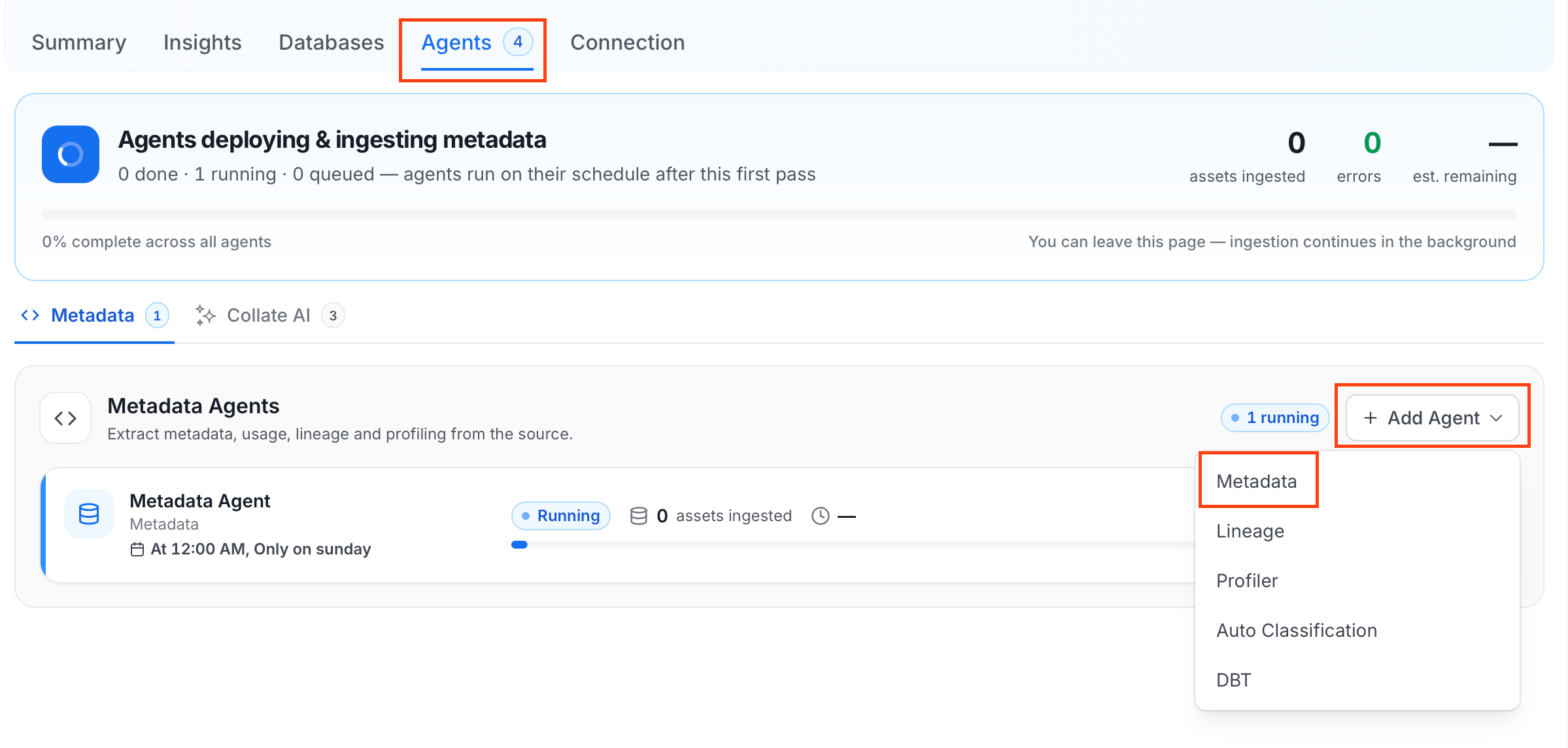 For some services, the dropdown is not available and clicking **Add Agent** takes you directly to the agent configuration page.
4. On the **Configure Ingestion** page, do the following and click **Next**.
* **Name this Ingestion**: Enter a unique recognizable name for this ingestion pipeline.
For some services, the dropdown is not available and clicking **Add Agent** takes you directly to the agent configuration page.
4. On the **Configure Ingestion** page, do the following and click **Next**.
* **Name this Ingestion**: Enter a unique recognizable name for this ingestion pipeline.
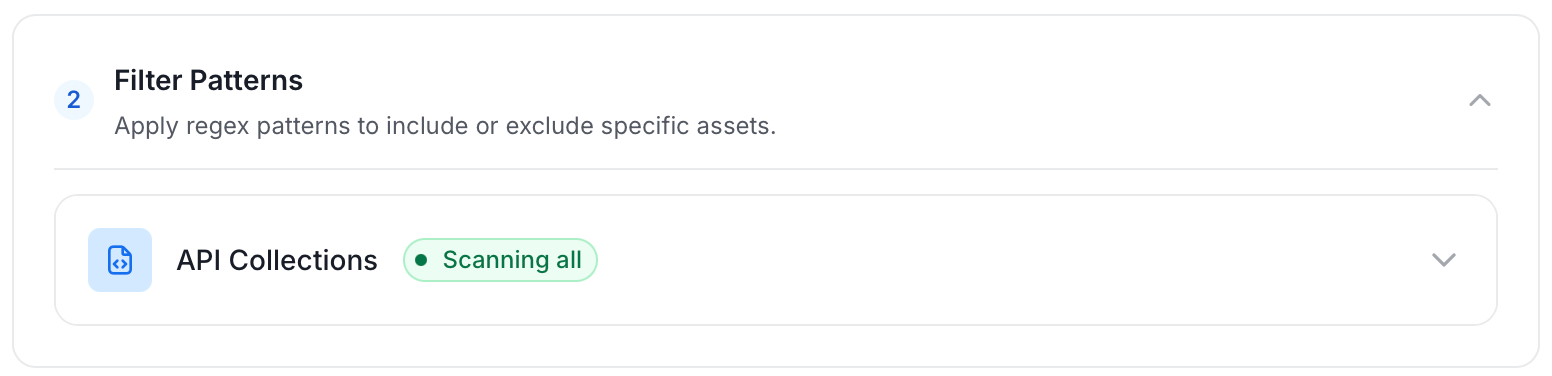
 * **Filter Patterns**: Apply include or exclude rules to scope which API collections and endpoints this agent ingests. These follow the same filter options described in **Step 5**.
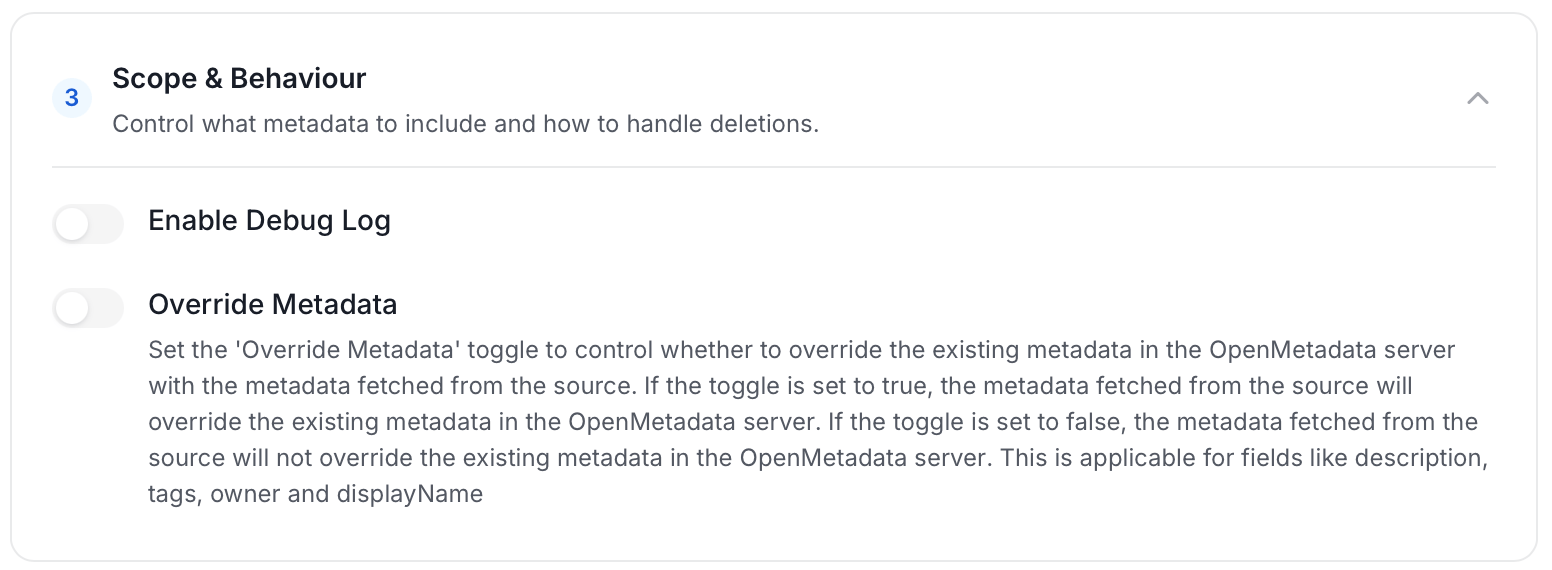
 * **Scope & Behaviour**: Control what metadata to include and how to handle deletions. Toggle each option on or off based on your needs:
| Toggle | Default | Description |
| ---------------------------- | ------- | ---------------------------------------------------------------------------------------------------------------------------------------------------------------------- |
| Mark Deleted API Collections | On | Soft-delete API collections in Collate when they are removed from the source. Associated entities like lineage are also deleted. |
| Override Metadata | Off | When on, source values overwrite existing descriptions, tags, owners, and display names in Collate. When off, Collate only updates fields that have no existing value. |
| Enable Debug Log | Off | Sets the ingestion log level to DEBUG. Useful for troubleshooting. |
* **Scope & Behaviour**: Control what metadata to include and how to handle deletions. Toggle each option on or off based on your needs:
| Toggle | Default | Description |
| ---------------------------- | ------- | ---------------------------------------------------------------------------------------------------------------------------------------------------------------------- |
| Mark Deleted API Collections | On | Soft-delete API collections in Collate when they are removed from the source. Associated entities like lineage are also deleted. |
| Override Metadata | Off | When on, source values overwrite existing descriptions, tags, owners, and display names in Collate. When off, Collate only updates fields that have no existing value. |
| Enable Debug Log | Off | Sets the ingestion log level to DEBUG. Useful for troubleshooting. |
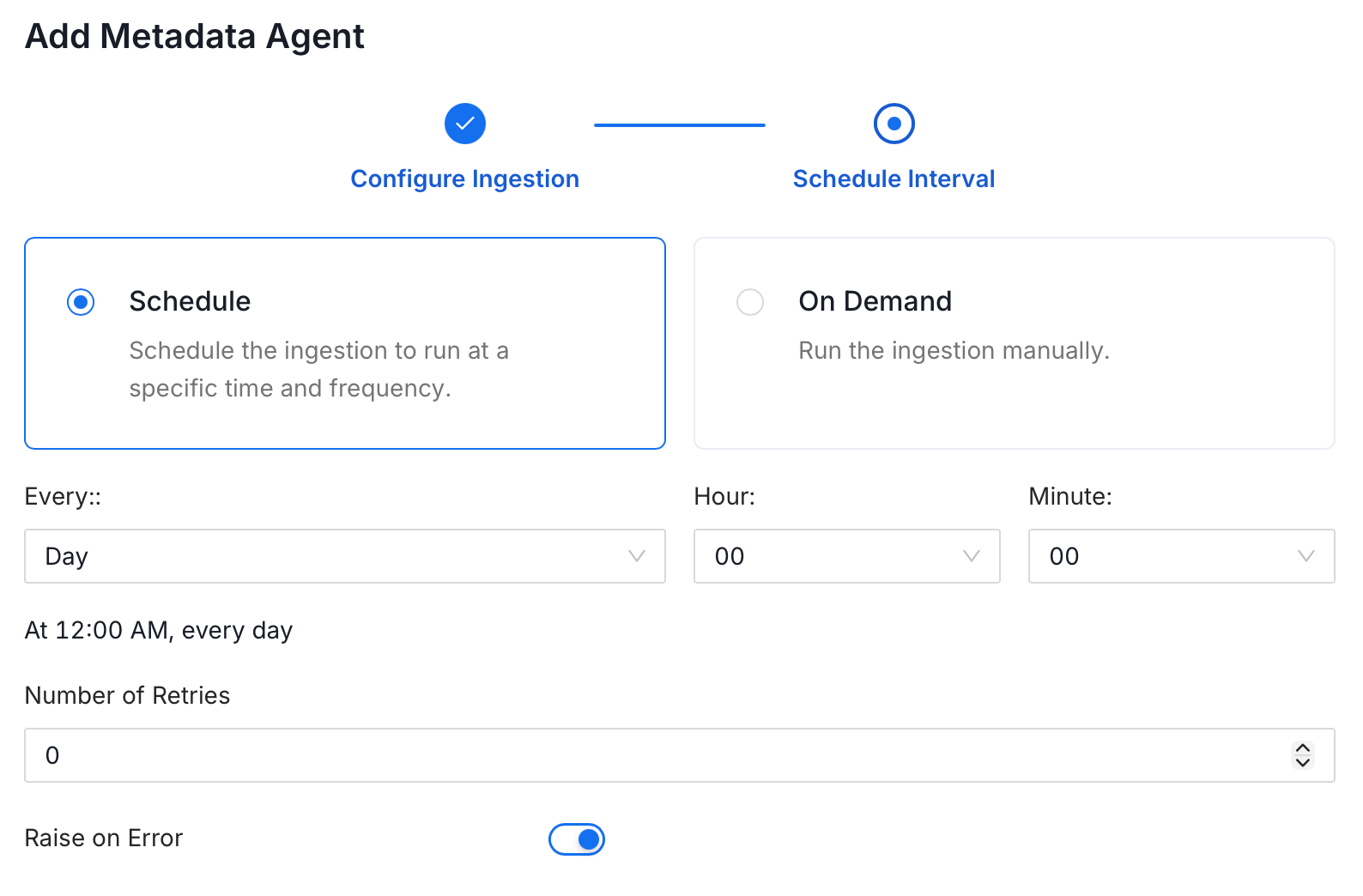
 5. On the **Schedule Interval** page, set when the agent runs:
* **Schedule**: Choose a preset interval (Hourly, Daily, Weekly, Monthly) or enter a custom cron expression.
* **On-Demand**: No automatic schedule; trigger the agent manually when needed.
5. On the **Schedule Interval** page, set when the agent runs:
* **Schedule**: Choose a preset interval (Hourly, Daily, Weekly, Monthly) or enter a custom cron expression.
* **On-Demand**: No automatic schedule; trigger the agent manually when needed.
 6. Click **Add** to deploy the agent.